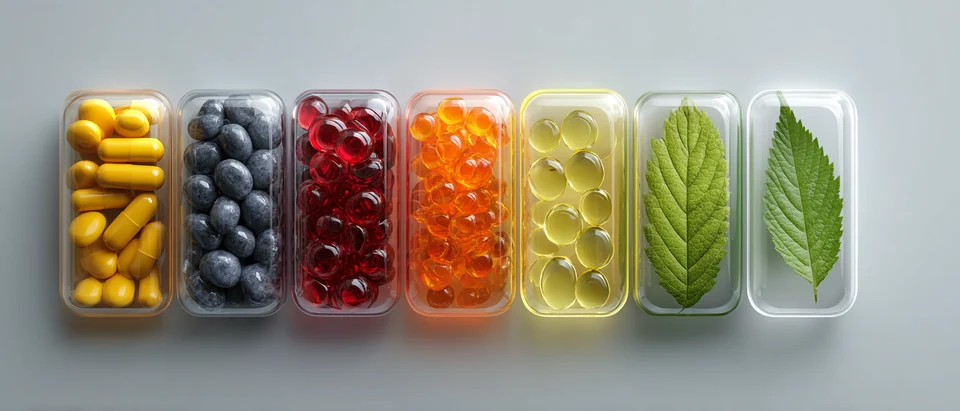
Common Mistakes in Dietary Supplement Formulation
Most consumer supplements fail not because the ingredients are wrong, but because the formulator treated the label as a shopping list rather than a chemical, biological, and pharmacokinetic system. Below is a working catalogue of the mistakes that recur across multivitamins, mineral blends, omega‑3s, probiotics, botanicals, and combination "stack" products — grouped by the underlying error rather than by ingredient.
1. Mineral–mineral antagonisms crammed into a single dose
The most persistent error is putting divalent cations that share intestinal transporters into the same capsule at high, simultaneous doses. Iron, zinc, calcium, copper, and magnesium compete at DMT1, ZIP/ZnT transporters, and paracellular routes, so a "complete" multimineral often delivers less of each mineral than a smaller, sequenced dose would.
Iron ↔ zinc.
At Fe:Zn ratios of ~2:1 or higher, iron reduces zinc absorption; in Caco‑2 competition studies, giving Fe, Cu, and Zn together at 1:1:1 inhibited Fe or Cu uptake by ~40%[1]. Solomons' foundational work reached the same conclusion in humans and warned specifically about "vitamin-mineral supplements and infant foods"[2].
Iron ↔ copper.
Copper inhibits iron uptake and, reciprocally, iron inhibits copper uptake, so high-dose iron in a multi silently drives copper status down over time[1].
Calcium ↔ iron.
Calcium is a non-competitive inhibitor of DMT1 and reduces iron uptake in Caco‑2 cells in a concentration-dependent manner[3]. The effect is partly a lumenal event at DMT1 and partly at the basolateral ferroportin step, though it may be short-lived enough that long-term calcium supplementation does not always show iron-status damage[4].
Iron/zinc ↔ calcium.
The reverse is also true: iron and zinc modulate calcium bioavailability, which matters for bone-health blends that stack all three[5].
The practical mistake: one giant "bone & blood" tablet with 18 mg Fe + 15 mg Zn + 500 mg Ca + 2 mg Cu, taken once daily. A better design either splits doses across the day, uses lower elemental amounts, or accepts a mono-mineral for the deficient nutrient.
2. Ignoring cofactors and required synergies
The opposite mistake — omitting nutrients that a "hero" ingredient functionally requires — is just as common.
Vitamin D without magnesium.
All the enzymes that activate vitamin D (25-hydroxylase, 1α-hydroxylase) and its binding protein are magnesium-dependent, and hypomagnesemia is a well-documented cause of vitamin D unresponsiveness[6]. High-dose D3 in magnesium-deplete patients can fail to raise 1,25(OH)2D. A bimodal-relationship RCT even shows the vitamin D response to supplementation depends on baseline magnesium status[7].
Vitamin D without K2.
D drives calcium absorption; K2 (menaquinones) activates matrix Gla protein and osteocalcin so that absorbed calcium is deposited in bone rather than in vascular soft tissue[8]. High-dose D3 monotherapy in a middle-aged consumer is not a neutral choice.
Iron without vitamin C or copper.
Nonheme iron absorption is ascorbate-dependent, and hemoglobin synthesis requires ceruloplasmin (copper-dependent) to mobilize iron out of stores. Iron-only formulas ignore both.
B12 without intrinsic-factor-independent dosing awareness.
In older adults or those with atrophic gastritis, a 10 µg B12 dose relying on intrinsic factor is very different from a 1000 µg dose relying on passive diffusion.
3. Wrong molecular form of a vitamin
Formulators frequently pick the cheapest USP-grade form without checking whether it matches human biochemistry.
Folic acid vs. (6S)-5-MTHF.
Folic acid is a synthetic, fully oxidized pteroyl-monoglutamate that must be reduced by DHFR — a slow, saturable enzyme in humans — to become bioactive. High doses produce measurable circulating unmetabolized folic acid (UMFA); a randomized trial in pregnant women showed folic acid supplementation increased human milk UMFA to ~28% of total milk folate versus ~2% with (6S)-5-MTHF, roughly a 14-fold increase in the proportion of UMFA in milk[9]. In a wild-type (no MTHFR polymorphism) patient, 5 mg/day folic acid produced elevated homocysteine that dropped to baseline within 5 days of switching to 500 µg 5-MTHF[10].
Cyanocobalamin vs. methyl-/adenosyl-/hydroxocobalamin.
Cyanocobalamin is a synthetic form that contributes a cyanide moiety and does not occur meaningfully in human tissues, whereas MeCbl, AdCbl and OHCbl are bioidentical forms all shown clinically to improve B12 status[11]. The nuance most formulators miss: all forms are still reduced to a core cobalamin intracellularly and re-converted, so for a healthy user the practical difference is smaller than marketing suggests — but for polymorphism carriers or heavy smokers, form choice matters[11].
Synthetic (all-rac) vs. natural (RRR-) α‑tocopherol.
All-rac‑α‑tocopherol contains eight stereoisomers, only one of which is RRR. The α-TTP liver transport protein is stereoselective, so synthetic vitamin E is preferentially metabolized and excreted as α‑CEHC in urine[12]. The conventional 1.36:1 or 2:1 equivalency assumption is empirically wrong: dose–effect curves are non-parallel, meaning no single ratio equates the two across tissues, doses, and timepoints[13]. A "high potency" 400 IU synthetic E is not simply 400 IU of natural E.
Vitamin K1 vs. MK-4 vs. MK-7.
K1 (phylloquinone) has a short half-life and hepatic tropism (coagulation); MK-7 has a much longer half-life and better carboxylates extrahepatic Gla-proteins. A "vitamin K" claim on the panel says almost nothing without the isomer and dose.
Magnesium oxide vs. glycinate/citrate/malate.
Oxide is cheap and abundant on labels precisely because it packs a lot of elemental Mg into a small tablet — but its solubility and human bioavailability are much lower than organic chelates.
Zinc oxide vs. bisglycinate/picolinate.
Same mistake as MgO; zinc oxide is often functionally inert without gastric acid.
Curcumin vs. formulated curcumin.
Native curcumin is poorly water-soluble, poorly absorbed, unstable at alkaline pH, and rapidly metabolized[14]. A "500 mg curcumin" cap without piperine, phospholipid complex, micelle, or nano-formulation delivers essentially nothing systemically[14].
4. Omega-3 oxidation — the invisible spoilage problem
Fish and algal oils are extraordinarily prone to peroxidation because EPA and DHA carry five and six methylene-interrupted double bonds. Oxidation produces primary (peroxides) and secondary (aldehydes, α,β-unsaturated carbonyls) products that are biologically active — potentially harmful, and quite possibly the explanation for the null results in several cardiovascular omega‑3 trials[15].
Real-world contamination is common:
- In a multi-year analysis of 72 marine and microalgal omega‑3 supplements, 68% of flavored and 13% of unflavored products exceeded the GOED voluntary TOTOX limit of ≤26, and flavoring itself confounds the standard p-AV assay used to measure secondary oxidation[16].
- In a Syrian-market survey of three brands, two exceeded PV and TOTOX limits from the start of the study and worsened over one year of storage[17].
- A UAE survey of 44 products found mean PV of 6.4 meq/kg against a GOED limit of 5[18].
Formulation errors that drive this:
- No antioxidants in the oil, or the wrong ones (α-tocopherol alone is a chain-carrier at high concentrations; mixed tocopherols + rosemary extract + ascorbyl palmitate perform better).
- Clear or PET packaging exposing product to light and oxygen.
- Softgel headspace not nitrogen-flushed; permeable gelatin shells.
- Flavoring agents that mask rancidity organoleptically and interfere with the p-anisidine assay so batch QC misses it[16].
- No published PV/p-AV/TOTOX on the CoA; virtually no clinical trials of omega‑3s report oxidation status of the trial oil, meaning even the evidence base is compromised[15].
- Long distribution chains and warm-climate retail with no stability data at 30 °C/75% RH.
- Co-formulating fish oil with pro-oxidant transition metals (iron, copper) in the same softgel or in shared blister packs.
5. Not understanding probiotics
Probiotics fail more often than any other category because formulators treat CFU on the label like an active drug mass. It isn't — it's a living population that dies through manufacture, packaging, shelf life, and gastric passage.
Ignoring strain specificity.
"Lactobacillus acidophilus" is not a claim; strain (e.g. LA-5, NCFM) determines clinical effect, and effects do not generalize across strains. Reviews of probiotic development explicitly flag "strong strain specificity and inconsistent reproducibility" as the field's central industrial problem[19].
Confusing label CFU with delivered CFU.
The commonly cited threshold for a clinically meaningful daily dose is 10⁸–10⁹ CFU/g, and formulations must contain at least this many viable organisms at end-of-life, not at manufacture[20].
Underestimating processing kills.
Bacteria are hit hard by temperature, humidity, pressure, oxygen, gastric acid, and bile[19, 20]. Microencapsulation can improve drying survival up to ~100-fold, but the effect is strain-dependent and non-transferable[19].
No moisture control.
Water activity above ~0.25 is catastrophic for freeze-dried powders; hygroscopic co-ingredients (vitamin C, minerals, botanical extracts) in the same capsule kill viability during shelf life.
Co-formulation with antagonists.
Putting probiotics in the same softgel as fish oil (peroxides), high-dose zinc, or antimicrobial botanicals (oregano oil, berberine) makes no biological sense.
Wrong dosage form.
Straight compressed tablets often lose viability faster than sachets or acid-protected capsules; the dosage-form choice is itself a determinant of end-of-life CFU[21].
"Synbiotic" as marketing rather than biology.
Prebiotics don't universally boost probiotics — the effect depends on the prebiotic type, dose, strain, and food matrix, and can be growth-promoting, neutral, or partially inhibitory[22].
No acid/bile protection.
Enteric coating or spore-forming strains (e.g. B. coagulans) exist precisely because most Lactobacillus strains die crossing the stomach; ignoring gastric survival negates the CFU number entirely.
6. Fat-soluble vitamins in the wrong matrix
Vitamins A, D, E, K need lipid, bile, and mixed micelles to be absorbed. The recurring mistake is putting them in a dry blend, or in an emulsion whose geometry defeats their release.
Systematic in vitro work shows droplet size and emulsifier choice can move β‑carotene bioaccessibility from ~15% to ~83%, and vitamin D bioaccessibility drops sharply when the carrier is an indigestible oil or contains cationic polysaccharides[23]. Calcium at high concentrations precipitates mixed micelles into insoluble soaps and drops β‑carotene bioaccessibility from ~66% to ~24%[23]. This is why calcium + fat-soluble vitamin combos in the same tablet are a formulation red flag, and why "dry D3 in a hard-shell cap with no oil" often underperforms an oil-based softgel.
7. Excipient mistakes
Excipients are not inert. Formulators reach for the cheapest lubricants and fillers without checking their effect on dissolution or drug/nutrient chemistry.
Magnesium stearate overuse.
It is a hydrophobic lubricant that, above ~1%, retards dissolution and can drop drug release[24]. In one BCS class-3 human bioequivalence study, capsules with HPMC or magnesium stearate showed measurably lower absorption of cimetidine and acyclovir[25]. In HCl salts of weak bases, magnesium stearate is the most deleterious excipient tested — it induces salt disproportionation and produces deliquescent MgCl2 that destroys tablet stability[26].
HPMC and other viscosity-forming polymers...
HPMC and other viscosity-forming polymers in immediate-release formulations can act as unintended sustained-release matrices.
Silicon dioxide, talc, titanium dioxide as fillers/opacifiers...
Silicon dioxide, talc, titanium dioxide as fillers/opacifiers — legal but unnecessary in a supplement whose consumer explicitly wants a "clean" label. TiO2 in particular is now banned as a food additive in the EU.
Sugar alcohols (sorbitol, mannitol)...
Sugar alcohols (sorbitol, mannitol) at unlabeled amounts can cause osmotic diarrhea that itself impairs absorption of everything else in the product.
No disintegrant, or the wrong disintegrant...
No disintegrant, or the wrong disintegrant — tablets that "look pretty" but never break apart in vivo. Basic USP disintegration testing is skipped by many contract manufacturers.
Hygroscopic excipients + moisture-sensitive actives...
Hygroscopic excipients + moisture-sensitive actives (probiotics, vitamin B1, methylcobalamin, iodides) in the same blend without desiccant.
8. Formula-matrix and dosage-form mistakes
Beyond individual excipients, the shape of the product is often wrong for what it's trying to deliver.
- One giant "one-a-day" that tries to be a multi + omega‑3 + probiotic + herbal blend. This forces incompatible chemistries (aqueous vs oil vs live) into shared moisture and headspace.
- No consideration of chrono-dosing. Iron in the morning on an empty stomach; magnesium and glycine at night; fat-soluble vitamins with the largest meal; calcium away from iron and thyroid meds. Splitting the same total dose across day parts almost always improves absorption and reduces antagonism.
- Enteric coating misused — used to "sound advanced" on turmeric or NAC while omitting it on probiotics where it actually matters.
- Liposomal and micellar claims without characterization. True liposomes require lamellarity, size distribution, and encapsulation efficiency; many "liposomal" products on the market are just lecithin emulsions.
- Same-capsule co-formulation of antagonists: iron + calcium, iron + zinc, calcium + fat-soluble vitamin without adequate lipid, curcumin + iron (chelation), green tea polyphenols + iron (tannin chelation), high-dose vitamin C + B12 (destruction of cobalamin), CoQ10 (oxidized ubiquinone) + high-dose vitamin C without a reducing environment.
- No stability data at real conditions. Accelerated stability (40 °C/75% RH for 6 months) is a minimum; many supplements ship with none.
9. Botanical-specific errors
- Extract standardization missing or wrong marker. "Curcuma longa 500 mg" without "standardized to 95% curcuminoids" is meaningless — it may be dried root powder at ~2% curcumin.
- Herb–micronutrient interactions ignored. Several botanicals reduce iron, folate, and ascorbate absorption or contribute to heavy-metal exposure, and formulators tend not to screen for this[27].
- Heavy metal contamination. In 11 adaptogenic supplements on the Polish market, Pb exceeded permissible limits by up to 235% and Ni by up to 321%, with tablets more contaminated than powders and Indian-sourced raw materials higher in Ni than Chinese[28]. An NYC Health Department dataset of 6,073 products found 99.6% of dietary supplements tested were above the 0.1 ppm lead limit for ingested substances, and 60% of tested supplements exceeded the 1 ppm mercury limit[29]. "Natural" is not a QC program.
- Whole-herb dose vs. extract dose confusion. 500 mg of a 10:1 extract is not equivalent to 500 mg of dried herb.
- Piperine as universal potentiator. Piperine inhibits CYP3A4 and P‑gp and will boost absorption of many drugs the consumer is also taking, not just the curcumin on the label.
10. Not understanding the biochemistry — where the errors converge
Most of the mistakes above are downstream symptoms of a small set of conceptual failures:
- Confusing dose with delivered dose. Label CFU, label mg, label IU are inputs. What matters is AUC, tissue level, or colonization — and formulators often have no PK data on their own product.
- Confusing chemical form with biological form. Cyanocobalamin, folic acid, all-rac α‑tocopherol, magnesium oxide, and pyridoxine HCl are all valid molecules; none of them are what the human enzyme actually uses. Ignoring the metabolic conversion step (and its saturable enzymes and polymorphisms) is the single most common biochemistry error.
- Confusing solubility with bioavailability. A water-soluble form is not automatically absorbed; a fat-soluble molecule needs bile and micelles; a polyphenol needs to survive first-pass glucuronidation.
- Ignoring pathway coupling. Methylation (folate + B12 + B6 + betaine + choline + Mg + zinc), one-carbon metabolism, iron/copper/ceruloplasmin, vitamin D/K/Mg/Ca, and the antioxidant network (vit E + vit C + glutathione + selenium + CoQ10) each function as a system. Overdosing one node without the others creates functional deficiencies of the rest (classic example: 400 IU E without vitamin C to regenerate α‑tocopheroxyl radical).
- Ignoring pharmacokinetics. Half-life, Tmax, and steady state matter: MK-7 does not need daily dosing while MK-4 does; a single 50,000 IU D3 bolus behaves very differently from 5,000 IU/day.
- Ignoring the gut as a chemical reactor. Chelation by phytates, tannins, oxalates; pH-dependent solubility; bile-dependent micellization; microbiome-mediated activation of polyphenols; competitive transporter saturation — none of this appears on the CoA, but all of it decides whether the product works.
- Ignoring inter-individual variation. MTHFR polymorphisms, ApoE genotype, gastric pH (PPI users), age-related intrinsic factor loss, and iron status all change the right form and dose. A single SKU cannot be optimal for everyone; formulators pretending it is are simply averaging over their responders.
- Poor quality control. Multivitamins routinely deviate from label claim; there is no standard regulatory definition of a "multi", no validated in vitro bioavailability model, and systematic bioavailability/bioequivalence data across marketed products is scarce[30].
Practical checklist a formulator can actually use
- Map the ingredient list against a mineral–mineral antagonism matrix and split doses across day-parts if antagonists co-exist.
- For every "hero" nutrient, list its required cofactors and confirm they are present at biologically meaningful ratios (Vit D + K2 + Mg; iron + vit C + copper; Ca + Mg + K2; methylation stack).
- Use bioactive forms by default: 5-MTHF, methyl-/adenosyl-/hydroxocobalamin, P5P, R5P, MK-7 alongside K1, chelated minerals, RRR-α‑tocopherol with mixed tocopherols/tocotrienols.
- For omega‑3s: nitrogen-flushed, opaque packaging, mixed tocopherol + rosemary + ascorbyl palmitate antioxidant system, published CoA with PV, p‑AV, and TOTOX, and real-condition stability out to expiry[15, 16].
- For probiotics: strain-level identification, end-of-life CFU (not manufacture CFU), moisture-controlled and desiccated packaging, no co-formulation with hygroscopic or antimicrobial ingredients, acid-protective delivery[19, 20].
- For fat-soluble vitamins and polyphenols: put them in a lipid, emulsion, phospholipid complex, or self-emulsifying system with characterized droplet size[14, 23].
- Minimize magnesium stearate; validate disintegration and dissolution on the finished product, not just the API[24, 26].
- Test every batch for heavy metals (Pb, As, Cd, Hg, Ni), microbial load, and (for oils) oxidation markers; publish the CoA[28, 29].
- Design for the user's pharmacogenetics and physiology when known (MTHFR, gastric acid status, age), and be honest when a single SKU is a compromise.
- Do accelerated and real-time stability at the actual pack-out — softgel, HPMC cap, blister, bottle, sachet — because the pack is part of the formulation.
The consistent lesson from the literature is not that supplements don't work; it is that most of them are engineered as if the human GI tract and enzyme network don't exist. Fixing that is mostly a matter of taking biochemistry, transporter physiology, and formulation stability seriously — before the label is written.