Across marketed or commercially plausible dietary-supplement and functional-food formulations, which documented formulation-, processing-, packaging-, gastrointestinal-, transport-, or metabolism-related mechanisms measurably impair identity, potency, release, bioaccessibility, systemic exposure, efficacy plausibility, or safety?
Across the full lifecycle from raw material to systemic circulation, the principal documented impairment mechanisms are gastrointestinal emulsifier-driven carrier destabilisation and droplet coalescence, encapsulant-dependent over-retention or degradation of bioactives during intestinal transit, food-matrix interference with micellarisation, moisture- and light-induced potency losses during storage, extreme formulation-format-dependent variation in mineral and iron bioaccessibility from marketed products, oxidative destruction of omega-3 fatty acids during digestion, and—for systemic safety—CYP3A4 induction by St. John's wort and CYP2D6 inhibition by goldenseal in controlled human studies, with mechanistically plausible but clinically unconfirmed UGT and transporter interactions from milk thistle, quercetin, and citrus flavonoids at supplemental doses.
Abstract
Across 80 empirical sources spanning marketed products, commercially plausible prototypes, human pharmacokinetic studies, and mechanistic in vitro experiments, multiple distinct lifecycle mechanisms measurably impair the identity, potency, release, bioaccessibility, systemic exposure, or safety of dietary supplements and functional foods. At the gastrointestinal stage, emulsifier surface charge and droplet size are the primary determinants of lipid-carrier survival: sucrose-ester emulsions coalesced from approximately 0.84 µm to 41–78 µm under gastric acidity, reducing carotenoid bioaccessibility to 8–27% versus 17–42% for stable Tween 80 systems [1], while large carotenoid emulsion droplets (~15 µm) suppressed β-carotene bioaccessibility to below 20% compared with ~66% for submicron formulations [2]. Polysaccharide encapsulant chemistry governs release at the intestinal stage: inulin/chitosan microparticles protected propolis phenolics from degradation but achieved only 0.6–12% bioaccessibility because retention was too strong [3], whereas sodium alginate–gelatin beads increased grape pomace phenolic bioaccessibility 4.5-fold relative to free extract [4]. Food-matrix co-administration introduces further unpredictability: lycopene bioaccessibility fell from 53.8% in a pure nanoemulsion to 6.2% upon incorporation into apple juice [5], while the same iron microcapsules showed near four-fold higher bioaccessibility with bread than when digested alone due to starch-wall hydrolysis releasing iron [6]. Among marketed supplements, six iron formulations showed bioaccessibility ranging from 0.07% to 96.55%, with the polydextrose–iron complex producing zero detectable intestinal absorption [7], and a powder multivitamin achieved up to 140-fold higher calcium bioaccessibility than a chemically matched tablet [8]. During storage, moisture-induced glass transition, deliquescence, and excipient-phase crystallisation are the dominant chemical-degradation drivers, reducing catechin content [9], ascorbate content by up to 78% [10], and probiotic viability when starch moisture exceeded 2% [11]. Gastrointestinal pro-oxidant conditions degraded omega-3 fatty acids in fish-oil supplements by 1310–2338% (MDAeq) with total bioaccessibility as low as 12.9% for some brands [12]. At the systemic stage, St. John's wort CYP3A4 induction (~141% increase in healthy elderly subjects) is the most robustly documented interaction [13], with clinical harm confirmed by case reports of neutropenia and potential paclitaxel inefficacy [14]; goldenseal produced the only in-human CYP2D6 inhibition (~50% reduction) in a controlled crossover study of six botanicals [15]. Milk-thistle flavonolignans were predicted to increase raloxifene systemic exposure 4.3–4.7-fold through intestinal UGT inhibition at clinically achievable intestinal concentrations [16], and quercetin co-administration reduced cyclosporine Cmax by 46–50% in rats through overlapping intestinal and hepatic enzyme-transporter modulation [17]. The evidence collectively demonstrates that impairment is not a single-point failure but a cascade beginning at raw-material physical state and culminating in systemic pharmacokinetic interactions, with the food matrix as a major but often untested modifying variable; most gastrointestinal findings rest on in vitro or simulated digestion evidence that has not been validated against human bioavailability, and only St. John's wort and goldenseal interactions are supported by adequately controlled human studies.
Paper search
We performed a semantic search across over 138 million academic papers from the Elicit search engine, which includes all of Semantic Scholar and OpenAlex.
We ran these queries:
- "dietary supplement OR nutraceutical OR functional food formulation stability excipient compatibility processing packaging oxidation moisture phase behavior degradation"
- "dietary supplement OR nutraceutical OR functional food dissolution simulated digestion gastric stability bioaccessibility micellization precipitation permeability absorption"
- "dietary supplement OR botanical OR nutraceutical pharmacokinetics CYP UGT transporter P-glycoprotein OATP BCRP drug interaction contamination toxicity"
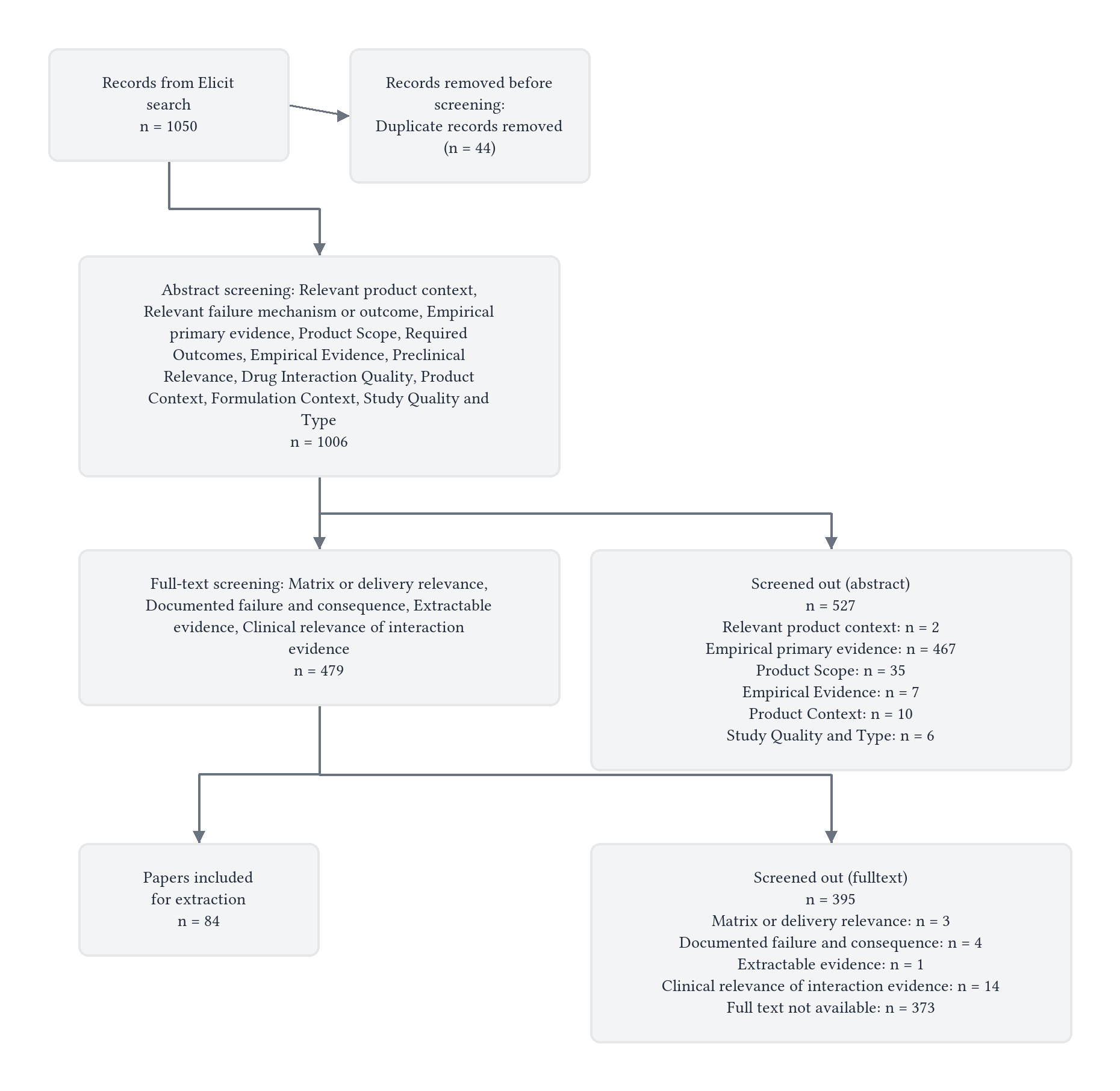
The searches returned 1,050 total results from Elicit.
We retrieved 1006 papers most relevant to the query for screening.
Screening
Abstract screening
We screened in sources based on their abstracts that met these criteria:
- Relevant product context: Does the title or abstract indicate a dietary supplement, nutraceutical, botanical, vitamin/mineral, probiotic, enzyme, lipid supplement, multi-ingredient product, functional-food formulation, or an explicitly relevant dosage-form/food matrix?
- Relevant failure mechanism or outcome: Does the title or abstract indicate a stability, incompatibility, process/package, dissolution/digestion, bioavailability/disposition, interaction, contamination, or toxicological issue?
- Empirical primary evidence: Is this an original experimental, analytical, observational, clinical, or pharmacokinetic report rather than a review, editorial, protocol, commentary, or conference-only abstract?
- Product Scope: Does the study focus on dietary supplements, nutraceuticals, botanicals, vitamins/minerals, probiotics, enzymes, lipid products, multi-ingredient products, functional-food matrices, or prototypes that model commercial products/delivery systems?
- Required Outcomes: Does the study report at least one of the following outcome measures: chemical/physical changes (assay loss, impurity formation, oxidation, hydrolysis, phase changes, aggregation, moisture uptake, shell cross-linking, viability loss, contaminant findings), dosage performance changes (disintegration, dissolution, precipitation, lipid digestion, bioaccessibility), disposition changes (permeability, transporter effects, metabolism, pharmacokinetics, metabolite formation, microbiome interactions), or safety/interaction findings?
- Empirical Evidence: Is this an empirical study with experimental validation (not purely theoretical or computational without experimental validation in relevant matrices)?
- Preclinical Relevance: If this is an in-vitro or animal study, does it test dietary supplement/functional food matrices, dosage forms, packaging systems, or mechanisms directly transferable to these applications?
- Drug Interaction Quality: If this is a drug interaction study, does it include human study data, validated clinical-relevance framework, or experiments tied to stated exposure/concentration data (not just uncontextualized screening results)?
- Product Context: Does the study avoid focusing solely on pure pharmaceutical drugs without any dietary supplement/functional food context?
- Formulation Context: Does the study avoid examining only raw ingredients tested outside of dietary supplement/functional food formulation contexts?
- Study Quality and Type: Is this study NOT a retracted study, conference abstract, case report, editorial, or opinion piece without original empirical data?
Papers that failed any criterion were automatically excluded; all other papers, including borderline ones, were screened in.
479 papers passed abstract screening and moved to full-text screening.
At abstract screening, the number of papers excluded for each primary reason was:
- Relevant product context: n = 2
- Empirical primary evidence: n = 467
- Product Scope: n = 35
- Empirical Evidence: n = 7
- Product Context: n = 10
- Study Quality and Type: n = 6
Full-text screening
We then screened papers based on their full text using these additional criteria:
- Matrix or delivery relevance: Is the material a finished commercial product, a supplement/functional-food dosage-form or food-matrix model, or a directly transferable formulation mechanism? Exclude a pure isolated compound tested without a matrix or delivery relevance.
- Documented failure and consequence: Does the report present a documented mechanism plus an observed or measured formulation, biopharmaceutical, pharmacokinetic, or safety consequence, rather than a speculative warning alone?
- Extractable evidence: Does the full text report quantitative data or an unambiguous qualitative analytical finding relevant to the failure mechanism?
- Clinical relevance of interaction evidence: For a drug interaction, is there a human study, a validated clinical-relevance framework, or experimental evidence linked to stated exposure or concentration? For non-interaction studies, mark yes.
Papers were included in the final analysis only if they met every criterion; papers that failed or were borderline on any criterion were excluded.
84 papers passed full-text screening and moved to data extraction.
At full-text screening, the number of papers excluded for each primary reason was:
- Matrix or delivery relevance: n = 3
- Documented failure and consequence: n = 4
- Extractable evidence: n = 1
- Clinical relevance of interaction evidence: n = 14
- Full text not available: n = 373
Data extraction
We asked a large language model to extract each data column below from each paper. We gave the model the extraction instructions shown below for each column.
Full citation and DOI:
Extract authors, journal, year, title, and DOI exactly as reported.
Product and formulation:
Identify the active(s), product type, dosage form/food matrix, and whether this is a marketed product, commercial sample, or prototype.
Lifecycle stage:
Assign one or more of: raw-material/solid-state physics; co-formulation; manufacturing; packaging/storage; gastric dissolution; intestinal transport/absorption; systemic fate/metabolic interactions; cross-cutting quality/regulatory.
Failure category:
Name the specific physical, chemical, biopharmaceutical, pharmacokinetic, or toxicological failure mode.
Mechanism:
State the molecular, physicochemical, or physiological pathway causing the failure.
Root cause:
Classify the proximate root cause: formulation error, excipient interaction, raw-material property, manufacturing/process stress, packaging/storage condition, gastrointestinal condition, transport/metabolic barrier, contaminant, or other; explain briefly.
Study system and evidence tier:
State the model and classify as human clinical/PK, human ex vivo, marketed-product analytical, formulation prototype analytical, simulated digestion, in vitro mechanistic, animal, or other.
Comparator and conditions:
Extract comparator, stress conditions, dose/concentration, timepoint, pH, storage, or co-administration conditions essential to interpret the result.
Quantitative impact:
Extract the numerical result(s), units, timepoint, and uncertainty/statistical significance if reported. If no quantitative value is reported, state the exact qualitative analytical finding.
Observed consequence:
State the demonstrated consequence for identity, potency, release, dissolution, bioaccessibility, systemic exposure, metabolite formation, interaction risk, or toxicity.
Quality-control method:
Extract analytical, physical-characterization, dissolution, digestion, pharmacokinetic, or contaminant-testing methods used to establish the result.
QbD prevention or engineering control:
Identify the authors' proposed mitigation, if any, and translate only directly supported evidence into a concise QbD control, such as critical material attribute, critical process parameter, packaging control, compatibility test, dissolution test, or clinical interaction assessment.
Regulatory or label-compliance status:
Report only whether the paper directly tested label claim, legal compliance, pharmacopeial compliance, or regulatory status. Otherwise state not assessed; do not infer compliance.
Product Type:
Extract the specific dietary supplement or functional food product type tested, including: Product category (e.g., botanical extract, vitamin/mineral, probiotic, enzyme, lipid product, multi-ingredient supplement, functional food matrix) Active ingredient(s) or bioactive compound(s) Delivery system or dosage form (e.g., capsule, tablet, powder, microparticle, nanoparticle, emulsion, micelle) Commercial status (marketed product, prototype modeling commercial product, or commercially plausible formulation)
Impairment Mechanism:
Extract the specific mechanism that caused measurable impairment to the dietary supplement or functional food, categorized as: Formulation-related (e.g., ingredient interactions, pH effects, ionic strength, polymer chemistry) Processing-related (e.g., spray-drying conditions, heating, pressure, crystallinity changes) Packaging/storage-related (e.g., moisture uptake, oxidation during storage, container interactions) Gastrointestinal-related (e.g., gastric pH, digestive enzymes, bile salts, protein corona formation) Transport-related (e.g., membrane permeability changes, transporter/efflux effects) Metabolism-related (e.g., presystemic metabolism, CYP interactions, microbiome biotransformation) Include the specific molecular or physical basis of the mechanism when reported.
Lifecycle Stage:
Extract the specific lifecycle stage where the impairment occurred: Raw material/solid-state physics Co-formulation/ingredient mixing Manufacturing/processing Packaging/storage Gastric dissolution Intestinal transport/absorption Systemic fate/metabolic interactions If multiple stages are involved, list all relevant stages and specify which was the primary source of impairment.
Impairment Type:
Extract what specific aspect of the dietary supplement or functional food was measurably impaired: Identity (chemical/physical changes, degradation, impurity formation, contamination) Potency (loss of active ingredient concentration, reduced viability) Release (disintegration, dissolution, precipitation changes) Bioaccessibility (reduced simulated digestion release, micellization impairment) Systemic exposure (reduced AUC/Cmax, altered clearance, permeability changes) Efficacy plausibility (bioactivity loss, antioxidant activity reduction) Safety (toxicant exposure, interaction potential, adverse metabolite formation) Specify the exact parameter that was impaired.
Quantitative Impact:
Extract all quantitative measurements showing the magnitude of impairment to dietary supplement or functional food performance, including: Baseline vs. impaired values with units Percentage change or fold-change in key parameters Statistical significance (p-values, confidence intervals) Effect sizes when reported Concentration-response relationships Time-course data showing progression of impairment Comparative data (e.g., crystalline vs. amorphous, with vs. without matrix) Focus on outcomes directly relevant to supplement/functional food efficacy or safety.
Experimental Conditions:
Extract key experimental conditions that influenced the impairment mechanism in dietary supplements or functional foods: Environmental factors (pH, temperature, ionic strength, oxygen exposure) Biological conditions (gastric vs. intestinal fluids, enzyme concentrations, digestion time) Formulation variables (particle size, polymer type, encapsulation method, food matrix composition) Processing parameters (spray-drying temperature, storage duration, packaging material) Analytical methods used to detect and quantify the impairment Include conditions that either promoted or prevented the impairment mechanism.
Study Design:
Extract study methodology relevant to mechanism discovery for dietary supplements and functional foods: Study type (in vitro digestion, human PK study, analytical stability, animal study) Analytical techniques used (HPLC, dissolution testing, particle characterization, bioaccessibility assays) Validation approaches for clinical relevance (exposure concentrations, physiological conditions) Comparison groups or controls Duration of observation Sample size for human studies Note whether the study design adequately supports conclusions about mechanism-impairment relationships.
Intervention Strategies:
Extract any formulation, processing, or delivery strategies tested to prevent or mitigate the identified impairment mechanisms in dietary supplements or functional foods: Protective formulation approaches (encapsulation, coating, stabilizers) Processing modifications (controlled crystallinity, alternative methods) Packaging solutions (barrier materials, controlled atmosphere) Co-administration strategies (with food matrices, timing optimization) Alternative delivery systems tested Effectiveness of mitigation strategies with quantitative outcomes Include both successful and unsuccessful intervention attempts.
Report
Due to the limitations of the AI model, we are only able to process 80 sources while writing a report. This report was written using the 80 sources that had the highest screening scores out of the 84 sources that we screened in and extracted data from.
Results
Characteristics of Included Studies
The 80 included sources span a wide range of product categories, lifecycle stages, evidence tiers, and impairment mechanisms. Full texts were retrieved for all sources; where detailed bibliographic metadata was incomplete in the extraction, this is noted. The table below summarises key characteristics of each study.
| Study | Full text retrieved? | Product category | Lifecycle stage(s) | Evidence tier | Primary impairment type |
|---|---|---|---|---|---|
| Bryszewska (2019) [6] | Yes | Vitamin/mineral iron supplements and microencapsulated iron [6] | Gastric dissolution; intestinal transport/absorption; co-formulation [6] | Simulated digestion; marketed-product analytical [6] | Bioaccessibility; oxidation/speciation [6] |
| Verkempinck et al. (2018) [1] | Yes | Carotenoid-enriched lipid emulsion [1] | Gastric dissolution; intestinal transport/absorption [1] | Simulated digestion; formulation prototype analytical [1] | Bioaccessibility; release [1] |
| Pinheiro et al. (2013) [18] | Yes | Curcumin oil-in-water nanoemulsion [18] | Co-formulation; gastric dissolution; intestinal transport/absorption [18] | Simulated digestion [18] | Bioaccessibility [18] |
| Selmani et al. (2024) [19] | Yes | Selenium nanoparticle supplement [19] | Gastric dissolution; intestinal transport/absorption; packaging/storage [19] | Simulated digestion; in vitro mechanistic [19] | Identity (colloidal destabilisation) [19] |
| Vellido-Perez & Martínez-Férez (2025) [20] | Yes | Curcumin functional-food delivery systems [20] | Co-formulation; gastric dissolution; intestinal transport/absorption [20] | Simulated digestion [20] | Bioaccessibility; systemic exposure [20] |
| Hasan et al. (2019) [21] | Yes | Curcumin nanoliposomes [21] | Co-formulation; gastric dissolution; intestinal transport/absorption [21] | Simulated digestion; formulation prototype analytical [21] | Release [21] |
| Vilcanqui et al. (2025) [22] | Yes | Gallic acid / ellagic acid inulin microparticles [22] | Raw-material/solid-state physics; co-formulation; gastric dissolution; intestinal transport/absorption [22] | Simulated digestion; formulation prototype analytical [22] | Release; bioaccessibility; efficacy plausibility [22] |
| Toro-Uribe et al. (2018) [23] | Yes | Cocoa alkaloid/catechin liposomes [23] | Co-formulation; manufacturing; gastric dissolution; intestinal transport/absorption [23] | Simulated digestion; formulation prototype analytical [23] | Bioaccessibility; potency/identity [23] |
| Bibi et al. (2017) [24] | Yes | Cinnarizine SNEDDS lipid-based system [24] | Intestinal transport/absorption; co-formulation [24] | In vitro mechanistic [24] | Systemic exposure (permeation) [24] |
| Pan et al. (2024) [25] | Yes | Astaxanthin liposomes [25] | Gastric dissolution; intestinal transport/absorption [25] | Simulated digestion; formulation prototype analytical [25] | Bioaccessibility; identity [25] |
| Cabezas-Terán et al. (2022) [26] | Yes | β-carotene mango-by-product microparticles [26] | Co-formulation; gastric dissolution; intestinal transport/absorption [26] | Simulated digestion; in vitro mechanistic [26] | Bioaccessibility; cellular uptake [26] |
| Cohen et al. (2017) [27] | Yes | Vitamin D3 casein micelles [27] | Co-formulation; gastric dissolution; intestinal transport/absorption [27] | Simulated digestion; in vitro mechanistic [27] | Potency; systemic exposure (in vitro) [27] |
| Katsouli et al. (2024) [5] | Yes | Lycopene/phenolic nanoemulsion beverage [5] | Co-formulation; manufacturing; packaging/storage; gastric dissolution; intestinal transport/absorption [5] | Simulated digestion; formulation prototype analytical [5] | Bioaccessibility; potency [5] |
| Zhang et al. (2021) [28] | Yes | Pea-protein Pickering emulsion [28] | Gastric dissolution; co-formulation [28] | Simulated digestion [28] | Release (gastric coalescence) [28] |
| Ye et al. (2020) [29] | Yes | Curcumin-whey protein microparticles in yogurt [29] | Raw-material/solid-state physics; manufacturing; co-formulation; gastric dissolution [29] | Simulated digestion; formulation prototype analytical [29] | Bioaccessibility; release; efficacy plausibility [29] |
| Cea-Pavez et al. (2024) [3] | Yes | Propolis extract microparticles (inulin/polymer) [3] | Co-formulation; manufacturing; gastric dissolution; intestinal transport/absorption [3] | Simulated digestion; formulation prototype analytical [3] | Bioaccessibility (degradation and over-retention) [3] |
| Pastore et al. (2020) [7] | Yes | Six marketed iron dietary supplements [7] | Gastric dissolution; intestinal transport/absorption [7] | Marketed-product analytical; simulated digestion; in vitro mechanistic [7] | Bioaccessibility; systemic exposure; safety [7] |
| Ubeyitogullari et al. (2019) [30] | Yes | Phytosterol nanoparticles in starch aerogels [30] | Raw-material/solid-state physics; manufacturing; gastric dissolution; intestinal transport/absorption [30] | Simulated digestion [30] | Bioaccessibility; release [30] |
| Martinović et al. (2023) [4] | Yes | Grape pomace phenolic microbeads (ionic gelation) [4] | Raw-material/solid-state physics; co-formulation; manufacturing; intestinal transport/absorption [4] | Simulated digestion; formulation prototype analytical [4] | Bioaccessibility [4] |
| Cruz-Molina et al. (2023) [31] | Yes | Grape marc extract WPI-pectin microcapsules [31] | Co-formulation; manufacturing; gastric dissolution; intestinal transport/absorption [31] | Simulated digestion; formulation prototype analytical [31] | Bioaccessibility; efficacy plausibility [31] |
| Niaz & Mackie (2024) [32] | Yes | β-carotene β-glucan-coated nanoliposomes [32] | Co-formulation; manufacturing; packaging/storage; gastric dissolution; intestinal transport/absorption [32] | Simulated digestion; in vitro mechanistic; animal ex vivo [32] | Release; bioaccessibility; systemic exposure [32] |
| Ortiz et al. (2009) [9] | Yes | Powdered green-tea formulation blends [9] | Raw-material/solid-state physics; co-formulation; packaging/storage [9] | Formulation prototype analytical [9] | Potency (catechin degradation) [9] |
| Hiatt et al. (2011) [10] | Yes | Sodium ascorbate-maltodextrin powder blends [10] | Raw-material/solid-state physics; co-formulation; packaging/storage [10] | Formulation prototype analytical [10] | Potency (ascorbate degradation) [10] |
| Abdelfattah et al. (2024) [33] | Yes | Anti-obesity nutraceutical blend (tablet/capsule/sachet) [33] | Co-formulation; manufacturing; packaging/storage [33] | Formulation prototype analytical [33] | Potency (storage-related loss) [33] |
| Estevinho (2025) [34] | Yes | Various encapsulated botanical/bioactive formulations [34] | Raw-material/solid-state physics; co-formulation; manufacturing; gastric dissolution; intestinal transport/absorption [34] | Other (editorial/overview) [34] | Efficacy plausibility; potency [34] |
| Baldim et al. (2020) [35] | Yes | Rosemary structured lipid carrier powders [35] | Manufacturing; co-formulation; raw-material/solid-state physics [35] | Formulation prototype analytical [35] | Efficacy plausibility (reduced antioxidant activity) [35] |
| dos Santos et al. (2011) [36] | Yes | Cholesterol/β-cyclodextrin inclusion complex [36] | Raw-material/solid-state physics; co-formulation; manufacturing; packaging/storage [36] | Formulation prototype analytical [36] | Release (complex instability) [36] |
| Marín et al. (2018) [37] | Yes | Freeze-dried liposomes in surimi gels [37] | Raw-material/solid-state physics; co-formulation; manufacturing; packaging/storage; gastric dissolution [37] | Formulation prototype analytical; simulated digestion [37] | Identity (aggregation); efficacy plausibility [37] |
| Melocchi et al. (2018) [38] | Yes | 3D-printed HPC nutraceutical capsule [38] | Manufacturing; raw-material/solid-state physics [38] | Formulation prototype analytical [38] | Identity (thermal HPC degradation) [38] |
| Mrázková et al. (2023) [39] | Yes | Nutraceutical cereal mixtures with edible flowers [39] | Co-formulation; manufacturing; packaging/storage [39] | Formulation prototype analytical [39] | Potency; efficacy plausibility [39] |
| Ibrahim et al. (2025) [40] | Yes | Pharmaceutical excipient particles (disintegrants/fillers) [40] | Raw-material/solid-state physics; packaging/storage [40] | In vitro mechanistic [40] | Release (premature swelling) [40] |
| Terakita et al. (2009) [41] | Yes | Lyophilised drug formulations (inositol/mannitol) [41] | Raw-material/solid-state physics; co-formulation; manufacturing; packaging/storage [41] | Formulation prototype analytical [41] | Potency (hydrolytic degradation) [41] |
| Pires et al. (2016) [42] | Yes | Echinacea purpurea tablets and syrup (marketed) [42] | Raw-material/solid-state physics; co-formulation; manufacturing [42] | Marketed-product analytical [42] | Efficacy plausibility; potency [42] |
| Chaves & Pinho (2018) [43] | Yes | Curcumin and cholecalciferol proliposomes [43] | Raw-material/solid-state physics; co-formulation; manufacturing; packaging/storage [43] | Formulation prototype analytical [43] | Potency (cholecalciferol loss) [43] |
| Grujić et al. (2018) [44] | Yes | Olive-leaf and vine-leaf extract capsules (marketed) [44] | Raw-material/solid-state physics; co-formulation; manufacturing; packaging/storage [44] | Formulation prototype analytical [44] | Potency; release (disintegration) [44] |
| Fussnegger et al. (2016) [45] | Yes | Raloxifene wet-granulated tablets (pharmaceutical model) [45] | Co-formulation; manufacturing; packaging/storage [45] | Formulation prototype analytical [45] | Identity (oxidative degradation) [45] |
| Escobar-García et al. (2024) [46] | Yes | Camu camu extract protein microencapsulates [46] | Raw-material/solid-state physics; co-formulation; manufacturing; packaging/storage [46] | Formulation prototype analytical [46] | Potency; efficacy plausibility [46] |
| Korčok et al. (2018) [11] | Yes | Probiotic/iron/vitamin C capsule [11] | Raw-material/solid-state physics; co-formulation; manufacturing; packaging/storage [11] | Formulation prototype analytical [11] | Potency (probiotic viability) [11] |
| Leyva-Porras et al. (2023) [47] | Yes | Functional food powder (maltodextrin/inulin/quercetin/probiotic) [47] | Raw-material/solid-state physics; co-formulation; manufacturing; packaging/storage [47] | Formulation prototype analytical [47] | Identity (microstructural collapse) [47] |
| O'Sullivan et al. (2025) [48] | Yes | Lipid-based pharmaceutical antioxidant model (ibuprofen) [48] | Co-formulation; packaging/storage [48] | Formulation prototype analytical [48] | Identity; potency (oxidative degradation) [48] |
| Rodionova et al. (2020) [49] | Yes | Sausage protective coatings (food safety) [49] | Packaging/storage; manufacturing [49] | Formulation prototype analytical [49] | Identity (surface mold) [49] |
| Choi & Song (2021) [50] | Yes | Herbal supplements (various) [50] | Systemic fate/metabolic interactions [50] | Other (narrative review) [50] | Systemic exposure; safety [50] |
| Gurley et al. (2005) [13] | Yes | Botanical supplements (SJW, garlic, ginseng, ginkgo) [13] | Systemic fate/metabolic interactions [13] | Human clinical/PK [13] | Safety (CYP modulation) [13] |
| Mohamed & Frye (2010) [51] | Yes | Top-selling herbal supplements (review) [51] | Systemic fate/metabolic interactions [51] | Other (systematic review) [51] | Safety (UGT interaction) [51] |
| Gurley et al. (2012) [52] | Yes | Popular botanical supplements (review) [52] | Systemic fate/metabolic interactions; intestinal transport/absorption [52] | Other (review) [52] | Safety; systemic exposure; identity [52] |
| Mohos et al. (2020) [53] | Yes | Quercetin and conjugates (in vitro) [53] | Intestinal transport/absorption; systemic fate/metabolic interactions [53] | In vitro mechanistic [53] | Safety (transporter inhibition) [53] |
| Orzetti & Baldo (2023) [14] | Yes | Botanical supplements (diosmin/escin/resveratrol; SJW) [14] | Systemic fate/metabolic interactions [14] | Human clinical/PK (case reports) [14] | Safety (CYP3A4 interaction) [14] |
| Gurley et al. (2008) [15] | Yes | Six commercial botanical extracts [15] | Systemic fate/metabolic interactions; gastric dissolution [15] | Human clinical/PK; marketed-product analytical [15] | Safety (CYP2D6 inhibition) [15] |
| Gufford et al. (2014) [54] | Yes | Milk-thistle and dietary constituents [54] | Systemic fate/metabolic interactions [54] | In vitro mechanistic [54] | Safety (UGT inhibition) [54] |
| Johnson et al. (2017) [55] | Yes | Grapefruit juice constituents [55] | Intestinal transport/absorption; systemic fate/metabolic interactions [55] | In vitro mechanistic [55] | Safety (OATP2B1 inhibition) [55] |
| Li et al. (2015) [56] | Yes | Licorice root extract [56] | Systemic fate/metabolic interactions [56] | In vitro mechanistic [56] | Safety (CYP inhibition) [56] |
| Butterweck et al. (2004) [57] | Yes | Herbal/dietary extracts (review) [57] | Systemic fate/metabolic interactions; intestinal transport/absorption [57] | Other (critical review) [57] | Safety; systemic exposure [57] |
| James et al. (2014) [58] | Yes | EGCG / green tea (animal) [58] | Systemic fate/metabolic interactions; intestinal transport/absorption [58] | Animal [58] | Systemic exposure; safety [58] |
| Roe et al. (2024) [59] | Yes | Botanical extracts (screening strategy) [59] | Intestinal transport/absorption; systemic fate/metabolic interactions [59] | Other (methodological strategy) [59] | Safety (hepatotoxicity; BDI) [59] |
| Tian et al. (2018) [60] | Yes | Green tea (Camellia sinensis) infusions [60] | Intestinal transport/absorption; systemic fate/metabolic interactions [60] | Human ex vivo; in vitro mechanistic [60] | Safety (UGT inhibition) [60] |
| Ohnishi & Yokoyama (2004) [61] | Yes | Health foods/supplements (review) [61] | Intestinal transport/absorption; systemic fate/metabolic interactions [61] | Other (narrative review) [61] | Systemic exposure; safety [61] |
| Liu et al. (2016) [17] | Yes | Quercetin (animal) [17] | Intestinal transport/absorption; systemic fate/metabolic interactions [17] | Animal [17] | Systemic exposure (CsA interaction) [17] |
| Obodozie (2012) [62] | Yes | Herbal medicines (review) [62] | Intestinal transport/absorption; systemic fate/metabolic interactions [62] | Other (review) [62] | Safety; systemic exposure [62] |
| Bajraktari-Sylejmani & Weiss (2020) [63] | Yes | Citrus flavonoids (in vitro) [63] | Intestinal transport/absorption; systemic fate/metabolic interactions [63] | In vitro mechanistic [63] | Safety (OATP inhibition) [63] |
| Kruger & Frank (2024) [64] | Yes | Polysorbate 80 micellar delivery [64] | Co-formulation; manufacturing; gastric dissolution; intestinal transport/absorption [64] | Simulated digestion; in vitro mechanistic [64] | Bioaccessibility [64] |
| Nguyen et al. (2019) [65] | Yes | Oil-based lipophilic micronutrient delivery [65] | Gastric dissolution; intestinal transport/absorption [65] | Simulated digestion; in vitro mechanistic [65] | Bioaccessibility (micellarisation impairment) [65] |
| Mehta et al. (2025) [66] | Yes | Nanotechnology nutraceutical delivery systems (review) [66] | All lifecycle stages [66] | Other (narrative review) [66] | Identity; potency; release; bioaccessibility; safety [66] |
| Lu et al. (2017) [67] | Yes | β-carotene O/W emulsions [67] | Co-formulation; manufacturing; gastric dissolution; intestinal transport/absorption [67] | Simulated digestion; formulation prototype analytical; in vitro mechanistic [67] | Bioaccessibility; systemic exposure (cellular uptake) [67] |
| Salvia-Trujillo et al. (2017) [2] | Yes | Carotenoid-enriched corn-oil emulsions [2] | Manufacturing; gastric dissolution; intestinal transport/absorption [2] | Simulated digestion [2] | Bioaccessibility (micellarisation) [2] |
| Grifoni et al. (2023) [68] | Yes | Cannabidiol nanostructured lipid carriers [68] | Co-formulation; manufacturing; gastric dissolution; intestinal transport/absorption [68] | Simulated digestion; formulation prototype analytical [68] | Bioaccessibility [68] |
| Pasidi & Vareltzis (2024) [69] | Yes | Vitamin D3 supplements and fortified foods [69] | Gastric dissolution; intestinal transport/absorption; manufacturing [69] | Simulated digestion; marketed-product analytical [69] | Bioaccessibility [69] |
| Wang et al. (2020) [70] | Yes | Quercetin olive oil-SPI/pectin emulsion [70] | Co-formulation; manufacturing; packaging/storage; gastric dissolution; intestinal transport/absorption [70] | Simulated digestion; formulation prototype analytical [70] | Bioaccessibility; release [70] |
| Sapp et al. (2023) [8] | Yes | AG1 powder vs. tablet multivitamin/mineral [8] | Raw-material/solid-state physics; manufacturing; gastric dissolution; intestinal transport/absorption [8] | Simulated digestion [8] | Release; bioaccessibility; systemic exposure [8] |
| Sapp et al. (2023a) [71] | Yes | AG1 foundational nutrition supplement vs. tablet [71] | Raw-material/solid-state physics; gastric dissolution; intestinal transport/absorption [71] | Simulated digestion [71] | Bioaccessibility; systemic exposure [71] |
| Floros et al. (2022) [12] | Yes | Fish-oil supplements, sardines, omega-3 eggs [12] | Raw-material/solid-state physics; co-formulation; manufacturing; gastric dissolution; intestinal transport/absorption [12] | Simulated digestion [12] | Bioaccessibility; identity (oxidation) [12] |
| Gasa-Falcon et al. (2019) [72] | Yes | β-carotene nanoemulsions [72] | Co-formulation; manufacturing; gastric dissolution; intestinal transport/absorption [72] | Simulated digestion [72] | Bioaccessibility [72] |
| Teleki et al. (2013) [73] | Yes | Micronutrient/nutraceutical particle delivery (review) [73] | All lifecycle stages [73] | Other (formulation review) [73] | Identity; potency; dissolution; bioaccessibility [73] |
| Mamagkaki et al. (2021) [74] | Yes | Genistein dietary supplement capsules [74] | Raw-material/solid-state physics; co-formulation; manufacturing; packaging/storage; gastric dissolution [74] | Formulation prototype analytical; animal PK [74] | Release; systemic exposure [74] |
| Sato et al. (2013) [75] | Yes | Cyclodextrin inclusion complexes for functional ingredients [75] | Raw-material/solid-state physics; co-formulation; packaging/storage; gastric dissolution; intestinal transport/absorption [75] | Other (formulation review + human pilot) [75] | Identity; potency; release [75] |
| Crișan (2024) [76] | Yes | NLC-based botanical supplement (tablet/capsule) [76] | Raw-material/solid-state physics; co-formulation; manufacturing; packaging/storage; gastric dissolution [76] | Formulation prototype analytical [76] | Identity (processing adhesion); release [76] |
| Tchabo et al. (2018) [77] | Yes | Mulberry leaf extract freeze-dried encapsulates [77] | Raw-material/solid-state physics; co-formulation; manufacturing; packaging/storage [77] | Formulation prototype analytical [77] | Potency; efficacy plausibility [77] |
| Kaci et al. (2023) [78] | Yes | Luteolin/naringenin and conjugates (in vitro) [78] | Systemic fate/metabolic interactions [78] | In vitro mechanistic [78] | Safety (transporter inhibition) [78] |
| Mohamed & Frye (2011) [79] | Yes | Herbal extracts (UGT screen) [79] | Systemic fate/metabolic interactions [79] | Human ex vivo (in vitro mechanistic) [79] | Safety (UGT inhibition) [79] |
| Nabekura et al. (2018) [80] | Yes | Natural polyphenols and P-glycoprotein [80] | Intestinal transport/absorption; systemic fate/metabolic interactions [80] | In vitro mechanistic [80] | Safety (P-gp induction) [80] |
| Gufford et al. (2015) [16] | Yes | Milk thistle flavonolignans [16] | Intestinal transport/absorption; systemic fate/metabolic interactions [16] | In vitro mechanistic [16] | Safety (UGT inhibition; systemic exposure) [16] |
The 80 sources divide into two substantively distinct clusters organised by research focus. The first, comprising roughly half the sources, addresses physical and chemical impairment occurring between raw-material production and intestinal bioaccessibility—encompassing the lifecycle stages of solid-state physics, co-formulation, manufacturing, packaging/storage, and gastrointestinal dissolution. The second cluster addresses enzymatic and transporter-mediated impairment of systemic exposure and drug safety, primarily involving CYP enzymes, UDP-glucuronosyltransferases, and organic anion-transporting polypeptides. Both clusters share the common thread that the final benefit of a supplement or functional food depends on processes that go well beyond label-declared bioactive content.
Thematic Analysis
Theme 1: Gastrointestinal Physical Destabilisation of Lipid-Based Delivery Systems
The largest single body of evidence concerns lipid-based carriers—emulsions, liposomes, nanostructured lipid carriers, and self-nanoemulsifying systems—and the degree to which gastric acidity and intestinal enzymatic conditions disrupt them before their bioactive payload can be absorbed.
For oil-in-water emulsions, the nature and concentration of the emulsifier is the dominant determinant of whether the carrier survives the gastric phase. Sucrose-ester-stabilised carotenoid emulsions underwent dramatic droplet coalescence under gastric conditions, increasing from initial sizes of approximately 0.84 µm to 41–78 µm, while Tween 80 emulsions remained stable [1]. The downstream consequence was reduced intestinal TAG hydrolysis (33–52% vs 53–57%) and substantially lower carotenoid bioaccessibility (8–27% vs 17–42%) [1]. The same destabilisation principle operated for curcumin nanoemulsions: cationic DTAB-stabilised systems underwent the greatest droplet-size increase and eventual phase separation, leaving curcumin in separated bulk oil and producing very low intestinal bioavailability, whereas Tween 20 systems retained structure and produced higher free-fatty-acid release [18]. The molecular basis is well-defined—strong electrostatic binding of anionic bile salts to the positively charged DTAB interface displaced the emulsifier [18] —illustrating how charge chemistry, not emulsifier identity per se, predicts gastrointestinal fate.
Droplet size, governed by processing intensity, operates as an independent impairment variable. In carotenoid corn-oil emulsions, large droplets (d43 ≈ 15 µm) impaired lipase adsorption at the oil–water interface, reducing TAG hydrolysis and limiting carotenoid incorporation into mixed micelles; final α- and β-carotene bioaccessibility was approximately 28% and 20%, respectively, versus 63% and 66% for submicron emulsions [2]. Similarly, β-carotene nanoemulsion studies found that lecithin at 8% was the only emulsifier formulation to produce 100% lipid digestibility and bioaccessibility of 23.5%, while sodium caseinate and sucrose palmitate at the same high concentration significantly reduced bioaccessibility through proposed carotenoid–protein complexation and mixed-micelle aggregation [72]. These findings collectively demonstrate that both inadequate particle-size reduction during manufacturing and inappropriate emulsifier choice create a bioaccessibility ceiling that cannot be overcome by encapsulation alone.
Liposomes present a distinct but related pattern. Phospholipase A2 and bile salts hydrolysed and disrupted phospholipid bilayers during intestinal digestion, causing marked losses for compounds with low intrinsic encapsulation affinity. Theobromine and caffeine in cocoa-extract liposomes, with encapsulation efficiencies of only 0.03% and 0.04%, showed bioaccessibilities of 8.4% and 31.5% versus 26.6% and 83.5% for the corresponding free compounds [23]. By contrast, catechin- and epicatechin-loaded liposomes—with encapsulation efficiencies around 44–48%—produced bioaccessibilities of 57.7% and 49.2%, approximately two-fold higher than free compounds [23]. Astaxanthin liposomes raised bioaccessibility from 6.54 ± 1.42% (free) to 39.61 ± 1.13% (encapsulated), attributed to easier transfer into mixed micelles [25]. Chitosan-coated liposomes slowed curcumin release further than uncoated systems, retaining approximately 90% after four hours of simulated gastric digestion [21], and β-glucan-coated liposomes provided sustained release but at the cost of bioaccessibility, which fell to 38 ± 11% versus 88.3 ± 9% for uncoated nanoliposomes [32]. This trade-off between protection and release speed is a recurring formulation dilemma.
For nanostructured lipid carriers, CBD achieved 100% recovery in simulated intestinal fluid after six hours despite particle-size growth from approximately 195 nm to 2000 nm during SIF digestion, suggesting that enzymatic rearrangement into an emulsion form preserved the drug's chemical integrity even when the carrier's physical structure changed [68]. Similarly, polysorbate 80 pre-micellisation improved curcumin bioaccessibility (32% for filtered micelles vs 15% for native compound with PS80), but lipase and bile partially disrupted the pre-formed micelles during digestion, demonstrating that no lipid-based strategy provides complete protection against gastrointestinal processing [64].
Micellar competition for bile salts is a mechanistic variant of the same problem. In a droplet-microfluidics digestion system, rapidly digested tricaprylin oils produced high lipolytic-product concentrations that competed with beta-carotene for bile-salt-micelle solubilisation, resulting in lower initial micronutrient release efficiency; beta-carotene release ranked TC > HOSO > fish oil, tracking the lipolysis rate [65]. This non-linear relationship between lipid digestion speed and micronutrient bioaccessibility is rarely captured by static digestion models.
Theme 2: Polymer Chemistry and Encapsulant Type Govern Gastrointestinal Release Control
Beyond the lipid class, polysaccharide- and protein-based encapsulants determine whether a phenolic or hydrophilic bioactive is protected during transit and released at the intended intestinal site.
Sodium alginate contracts under gastric low-pH conditions and swells at intestinal neutral-to-alkaline pH, producing a gastric-retention effect that, depending on wall composition, shifts from protection to excessive retention. SA-GEL microbeads (sodium alginate–gelatin) produced the highest phenolic bioaccessibility from grape pomace extract, with SA-GEL increasing the total phenolic bioaccessibility index 4.5-fold relative to unencapsulated extract, while SA-CHIT increased it only 2.2-fold [4]. Comparable formulation-dependent patterning appeared in propolis microparticles: inulin/chitosan provided the strongest protection from gastrointestinal degradation but achieved practically no intestinal release, with prenyl caffeate isomer 2 reaching only 0.6% recovery after 120 minutes of intestinal digestion, while inulin/sodium alginate produced higher bioaccessibility for the same compounds [3]. This represents a formulation failure of the opposite type from lipid instability—the shell is too protective, not too fragile.
Inulin encapsulation of phenolic compounds demonstrated that the physical state of the carrier—amorphous versus semicrystalline—is itself a determinant of release. Semicrystalline ellagic-acid particles (crystallinity index 23.5%) released 277.5 µg versus 198.2 µg from amorphous particles (crystallinity index 2.1%) during intestinal digestion, and achieved 14.3% vs 10.3% bioaccessibility [22]. This was controlled by process conditions: 36.5% ethanol and 114°C produced semicrystalline particles, while 6.8% ethanol and 148°C produced amorphous particles [22]. Gallic acid behaved oppositely—the more soluble compound released nearly 100% in the gastric phase from both particle types—demonstrating that compound physicochemistry interacts with crystallinity to determine the release profile [22].
WPI–pectin nano-spray-dried microcapsules increased bioaccessible phenolics from grape marc extract to 82% after simulated gastrointestinal digestion versus 54% for free extract [31], and whey–pectin microparticles from the same approach improved grape marc phenolic stability throughout digestion [31]. Casein micelles protected vitamin D3 through the gastric phase, retaining approximately 85% after combined gastric and intestinal digestion versus approximately 15% for free vitamin D3 [27], primarily by forming a gel curd near the casein isoelectric point that sequestered the vitamin from gastric acid [27].
The critical practical consequence of these findings is that encapsulant type must be matched to the target release site. Chitosan-type systems may be preferred when colonic delivery is intended, but are poorly suited when intestinal release and absorption are the goal. Alginate and pectin systems release in the small intestine but require thickness and crosslink density optimisation. Prebiotic inulin in microparticle walls has a secondary benefit: at 10 mM bile salts, inulin-containing β-carotene microparticles achieved 41.8% bioaccessibility versus 17.8% for particles without prebiotics [26].
Theme 3: Food-Matrix Co-Administration Causes Unpredictable Bioaccessibility Modifications
Multiple studies demonstrate that the same formulation performs very differently depending on the food matrix with which it is co-administered or incorporated. This is one of the most practically consequential and underappreciated impairment mechanisms.
Lycopene bioaccessibility fell from 53.8 ± 4.2% in a pure olive-pomace-oil nanoemulsion to 6.2 ± 1.8% when the same nanoemulsion was incorporated into pasteurised apple juice at a 25:1 ratio [5]. The authors proposed that apple-juice dilution slowed micellar solubilisation while pectin interfered with pancreatic enzyme activity and mixed-micelle incorporation [5]. This near nine-fold reduction in bioaccessibility within the same formulation represents an impairment mechanism that would not be captured by testing the nanoemulsion alone.
Iron microencapsulates showed a different pattern: microencapsulated ferrous lactate without vitamin C had 12.8% bioaccessibility when digested alone, but 49.3% with bread—a near four-fold increase driven by enzymatic starch hydrolysis releasing the iron from the modified-starch shell [6]. Conversely, vitamin-C-containing iron microcapsules (Mi2 and Mi4) showed reduced bioaccessibility in the presence of food (59.4% and 59.0%) versus alone (92.9% and 106.5%), likely because phytic acid in bread chelated iron and partially counteracted the vitamin-C protective effect [6]. This bidirectional interaction—where food can either enhance or reduce bioaccessibility depending on the specific matrix composition—makes in-vitro testing without a food matrix an incomplete quality indicator for marketed supplements.
Curcumin-whey protein microparticles showed reduced early gastric release when incorporated into yogurt: the rapid-release formulation discharged approximately 30% during the first 30 minutes of simulated gastric digestion in yogurt versus approximately 61% without yogurt, because yogurt proteins entrapped the microparticles [29]. This is a concrete example of how dairy co-formulation slows curcumin release in a way that might be beneficial for targeted delivery but could equally impair bioaccessibility if intestinal absorption relies on early dissolution.
The vitamin D3 literature provides quantitative evidence that the supplement matrix matters more than the supplement type. Foods (egg, salmon, cereals, sour cherry juice) had bioaccessibility indices of 1.04–1.10, while supplements were consistently below 1.0 and milk was only 0.40—the lowest of all tested matrices, attributed to calcium soap formation and casein/β-lactoglobulin binding that sequestered vitamin D3 [69]. Among supplements, oil-based liquid drops outperformed capsules and tablets, with tablets losing 55% of vitamin D3 during gastric digestion and a further 75% during intestinal digestion [69].
A counterintuitive gastric-pH result for vitamin D3 reinforces the complexity: lower gastric pH (pH 1 vs pH 7) caused more vitamin D3 loss during the gastric phase but produced higher intestinal content and bioaccessibility (BI 0.74 vs 0.43), apparently because acid-promoted lipid hydrolysis generated more free fatty acids and mixed micelles for intestinal vitamin D3 incorporation [69]. This illustrates that gastric destruction and intestinal enhancement can operate simultaneously and that optimising for one stage may inadvertently improve the other.
Theme 4: Packaging and Storage Conditions Drive Chemical Potency Losses
A substantial subset of studies focuses on post-manufacturing degradation during storage, where moisture, temperature, light, and oxygen interact with formulation composition to reduce bioactive potency before the product reaches the consumer.
Moisture is the dominant driver at the solid-state level. In powdered green-tea formulations, the glass-transition temperature of amorphous green-tea extract fell below 22°C storage temperature between 59% and 68% relative humidity; adding citric acid lowered Tg further to 18.0 ± 2°C at 59% RH, compromising catechin stability at a moisture level that was stable for green tea alone [9]. Deliquescence of co-formulated citric acid below its standalone RH₀ was the proximate mechanism: synergistic moisture uptake caused partial dissolution and catechin degradation associated with solid-solution transformations [9]. For sodium ascorbate, degradation reached 77.8% after four weeks at 98% RH when stored alone, reduced to 34.3% with M100 maltodextrin—not because the maltodextrin prevented moisture uptake but because it increased solution viscosity, reduced reactant mobility, and delayed oxidative degradation [10].
The lyophilised-formulation literature extends this principle to pharmaceutical systems with nutraceutical relevance. Amorphous inositol formulations demonstrated superior stability versus mannitol at 2% water by restricting water mobility (T1 values of 5.3 ms vs 5.3 ms at 20°C, diverging at 40–55°C), but at 8% water, crystallisation of inositol expelled absorbed water as a highly mobile free-water fraction, reversing the stability advantage and allowing TAK-457 content to fall to approximately 20% after 14 days [41]. This excipient phase-transition mechanism—where the protective amorphous form becomes a liability above a critical moisture content—applies directly to spray-dried supplement powders.
Probiotic viability in multi-ingredient capsule formulations was similarly moisture-sensitive: starch containing 5% moisture produced unsatisfactory water-activity outcomes, while 2%-moisture starch maintained L. plantarum 299v at 10⁹ CFU/capsule over 30 months with water activity rising from 0.15 to only 0.19 [11]. The functional food powder combining maltodextrin, inulin, quercetin, and Bacillus clausii retained antioxidant activity (54.6–58.5% DPPH scavenging) and probiotic viability (6.3–6.7 log CFU/g) across a range of water activities, but above aw 0.531 the material became sticky and crystallised, and at aw 0.856 it formed a continuous mass, losing its powder physical identity entirely [47].
Light and temperature compound moisture-related losses. In nutraceutical cereal mixtures containing edible flowers, one year of storage under sunlight at 23°C reduced total phenolic content by up to 53%, total anthocyanin content by up to 62%, glycosylated anthocyanins by 35–67%, and DPPH antioxidant activity by up to 25% [39]. Storage at 40°C produced similar but slightly less severe losses, while dark storage at 23°C was the most protective [39]. Vacuum polyamide/polyethylene packaging limited oxygen-related oxidation; the residual drivers were heat and light rather than oxygen. Camu camu polyphenol microencapsulates showed up to 30% DPPH inhibition decay under 56% RH or UV exposure over 40 days, with zein encapsulation at 2:1 providing the best preservation and WPC at 1:1 the least [46].
Oxidative degradation in lipid-based supplements during storage follows from the same chemical logic. In pharmaceutical ibuprofen-in-soybean-oil model formulations stored under nitrogen in amber glass, the antioxidant-free control reached a peroxide value of 81.4 meq O₂/kg at 12 months, exceeding the pharmacopeial limit by month nine, while API retention fell to 58.6% [48]. A combined BHT–α-tocopherol formulation was the most protective (peroxide value 9.8 meq, API 96.8%), exploiting mechanistic synergy where BHT quenched lipid radical chains in the oil phase and α-tocopherol scavenged peroxyl radicals at the lipid–water interface [48]. However, quercetin showed strong DPPH radical-scavenging activity in solution but poor protection in the lipid formulation because its poor oil-phase solubility meant it did not localise at the oxidation-initiating interface [48] —a demonstration that in-solution antioxidant assays do not predict formulation performance.
Peroxide contamination from excipients, not just from environmental oxygen, is a distinct source of oxidative impairment. Povidone binders containing >200 ppm peroxides produced approximately 0.02% raloxifene N-oxide formation at 40°C/75% RH within one month, while PEG-PVA binders containing <17 ppm produced 0% N-oxide throughout six months [45]. Packaging also modulated this: EVOH (PeroXeal) packaging or low-peroxide PVP K30 LP produced no detectable degradation, while standard polyethylene in-liner packaging did not prevent peroxide-mediated impairment [45]. This excipient-sourced contamination mechanism is not captured by simply controlling storage atmosphere.
Theme 5: Physical-State Engineering at the Raw-Material and Manufacturing Level Determines Downstream Performance
Several studies demonstrate that impairment is locked in during manufacturing rather than being imposed later by storage or digestion conditions.
Phytosterol bioaccessibility provides the clearest example: crude crystalline phytosterols achieved only 3% bioaccessibility after sequential digestion, rising to 35% when impregnated into nanoporous starch aerogels using supercritical CO₂ to generate low-crystallinity nanoparticles of approximately 68–69 nm [30]. The physical-mixture comparator—crude phytosterols simply blended with empty aerogel—achieved only 3.2%, confirming that nanoparticle formation, not matrix co-exposure, was the effective intervention [30]. Aggregation during impregnation (in the PS-NSA-3F preparation) reduced intestinal bioaccessibility to 16.9% versus 32.6% for the non-aggregated PS-NSA-F, even with similar particle sizes at approximately 69 nm [30].
Genistein capsule formulation illustrates the gap between in vitro dissolution and in vivo systemic exposure. Five hard-shell capsule formulations produced by dry granulation reached different dissolution endpoints (80.5–84.2% vs 100% for the optimised formulation 2 at 75–90 minutes) and different disintegration times (8–10.3 min) [74]. In a rat pharmacokinetic comparison, the optimised formulation achieved 34% higher Cmax (254 vs 190 ng/mL) and 10% higher AUC than a marketed reference formulation [74]. While the sample was only three rats per group, this result demonstrates that process-related dissolution differences can translate to measurable systemic-exposure differences for a BCS Class II supplement compound.
Spray-drying conditions for curcumin-WPI microparticles similarly determined loading capacity: without desolvation (ethanol addition to precipitate WPI around curcumin), only 0.37 mg curcumin per gram of particle was achieved; desolvation followed by spray-drying increased loading to 3.47 mg/g [29]. Calcium-ion crosslinking at 5 mM then shifted the release profile from rapid (87% released before simulated intestinal phase in yogurt) to targeted (44% released before intestinal entry) [29]. These are manufacturing levers that can be designed to control release kinetics independently of the downstream food matrix.
Theme 6: Systemic Metabolism and Transporter-Mediated Drug Interactions Represent a Distinct but Clinically Significant Impairment Category
The second major cluster of evidence deals with pharmacokinetic interactions where supplement constituents alter the clearance or bioavailability of co-administered drugs. Unlike the gastrointestinal impairment mechanisms above, the harm here falls primarily on the co-administered medication rather than on the supplement's own efficacy.
St. John's wort (Hypericum perforatum)
The human clinical evidence establishes St. John's wort (Hypericum perforatum) as the most consequential CYP-inducing supplement. After 28 days of supplementation at 300 mg three times daily, CYP3A4 activity increased by 141% (range 58–725%) in healthy elderly volunteers, with the CYP2E1 ratio also increasing by 26% [13]. The mechanism—hyperforin activation of the steroid xenobiotic receptor, inducing CYP3A4 and MDR1 gene expression—was clearly documented [13], and the clinical consequence table lists documented reductions in ciclosporin, indinavir, ethynylestradiol, theophylline, warfarin, and digoxin plasma concentrations [61]. Two clinical case reports provided direct evidence of harm: one patient taking diosmin, escin, and resveratrol with ribociclib developed moderate neutropenia (0.83 × 10³/µL), attributed to CYP3A4 inhibition by the supplement constituents increasing ribociclib exposure; a second patient planned to take St. John's Wort and lemon balm alongside paclitaxel, which was averted when the treating pharmacist identified the CYP3A4-induction risk [14].
Goldenseal (Hydrastis canadensis)
Goldenseal (Hydrastis canadensis) produced the only statistically significant CYP2D6 inhibition in a controlled crossover study of six botanical supplements, reducing the debrisoquine urinary recovery ratio by approximately 50% (post/pre ratio 0.53; 90% CI 0.44–0.64), consistent with hydrastine and berberine's known CYP inhibitory properties [15]. The five other tested botanicals—kava kava, milk thistle, black cohosh, St. John's wort, Echinacea—produced no significant CYP2D6 effect [15]. An important formulation-related observation was that the coated St. John's wort tablet required 44.8 minutes to disintegrate versus 3.5 minutes for goldenseal, raising the possibility that dissolution limitation could mask anticipated CYP effects—a reminder that dosage-form performance affects not only supplement bioaccessibility but also interaction potential [15].
UDP-glucuronosyltransferase-mediated interactions
UDP-glucuronosyltransferase-mediated interactions represent a less-studied but mechanistically substantial impairment pathway. Green-tea catechins ECG and EGCG inhibited intestinal UGT-mediated raloxifene glucuronidation in a concentration-dependent manner, with a mechanistic static model predicting raloxifene AUC increases of 4.4–6.1-fold using intestinal-lumen catechin concentrations from a standard 240-ml cup of green tea [60]. Milk thistle flavonolignans silybin A and silybin B inhibited raloxifene intestinal glucuronidation with Ki values of 27–66 µM in human intestinal microsomes, with modelling predicting 4.3- to 4.7-fold increases in raloxifene systemic exposure from silymarin or silibinin at clinically achievable intestinal concentrations [16]. EGCG inhibited UGT1A4 with an IC₅₀ of 33.8 ± 3.1 µg/mL, and milk thistle inhibited UGT1A6 and UGT1A9 with IC₅₀ values of 59.5 and 33.6 µg/mL, respectively [79].
Transporter-mediated interactions
Transporter-mediated interactions add another layer. Quercetin and its circulating conjugates (quercetin-3′-sulfate, quercetin-3-glucuronide, isorhamnetin) inhibited OATP1B1 with IC₅₀ values as low as 0.33 µM, OATP2B1 as low as 0.34 µM, and BCRP as low as 0.06–0.13 µM [53]. At high-dose supplementation (200–1000 mg/day), circulating quercetin conjugate concentrations can reach the micromolar range relevant to these IC₅₀ values. Citrus polymethoxyflavones nobiletin, sinensetin, and tangeretin inhibited hepatic OATP1B1 at 2.1–8.0 µM and OATP1B3 at 5.6–21.1 µM, while all six tested citrus flavonoids inhibited intestinal OATP2B1 at 1.6–14.2 µM [63]. Luteolin and naringenin sulfate/glucuronide conjugates showed potent OATP2B1 inhibition with IC₅₀ values of 0.26–0.42 µM for luteolin sulfate and related glucuronides [78]. Dietary pretreatment with EGCG in mice reduced subsequent plasma EGCG exposure by 57% and hepatic exposure by 71%, proposedly through induction of Phase II metabolic enzymes and active efflux transporters, and also markedly reduced acute hepatotoxicity from a high-dose oral bolus [58]. In rats, quercetin co-administration reduced cyclosporine Cmax by 46–50% and AUC0–t by 21–33% depending on dose, with dose-dependent inhibition of intestinal and hepatic CYP3A1/CYP3A2, UGT1A, and OATP expression [17]. Licorice root extract inhibited CYP2B6, CYP2C8, CYP2C9, and CYP2C19 with IC₅₀ values of 12–20 µg/mL [56], consistent with reports of multiple drug interactions in populations using licorice-containing products.
Dietary polyphenols also induced intestinal P-glycoprotein
Dietary polyphenols also induced intestinal P-glycoprotein, the opposite of the OATP-inhibition direction. Honokiol, magnolol, CAPE, xanthohumol, and anacardic acid activated the MDR1 promoter primarily through PXR in LS174T intestinal cells and decreased uptake of fluorescent P-glycoprotein substrates [80]. This induction mechanism can reduce oral absorption of P-glycoprotein substrates, potentially diminishing therapeutic drug exposure.
A critical methodological issue
A critical methodological issue in the in-vitro UGT and transporter interaction literature is the potential for inhibitor depletion to underestimate interaction potency. For silybin B, apparent IC₅₀ values shifted 1.3-fold at 10 minutes and 1.9-fold at 20 minutes in human intestinal microsomes and 2.8-fold in human liver microsomes, because rapid glucuronidative clearance of silybin reduced its effective concentration during the incubation [54]. This methodological issue means that screening IC₅₀ values for rapidly-metabolised botanical constituents systematically underpredict interaction risk [54]. The green-tea biochemometrics study explicitly addressed this by using short 4-minute reaction times and comparing intestinal-lumen versus enterocyte catechin concentrations as exposure scenarios, recognising that the two give 4.4–6.1-fold versus 1.2–1.3-fold predicted raloxifene AUC increases [60].
Theme 7: Formulation-Driven Impairment of Iron, Mineral, and Micronutrient Bioavailability from Marketed Products
Several studies examined commercially available rather than prototype formulations, providing direct evidence that formulation-related failures occur in marketed products reaching consumers.
The six marketed iron supplements
The six marketed iron supplements from Pastore et al. (2020) demonstrated extreme formulation-dependent variation in bioaccessibility: 0.07% for microencapsulated iron plus folate, 0.5% for a polydextrose–iron complex, and 96.55% for iron–succinylated protein complex, with the polydextrose complex producing zero detectable intestinal iron absorption or ferritin induction at either one or three hours [7]. The sucrosome formulation showed slower kinetics (bioavailability peaking at three hours rather than one hour) and was the only supplement to produce a significant adverse safety signal—measurably increased epithelial permeability and decreased TEER—attributed to the sucrester acting as an absorption enhancer [7]. These are all commercially marketed products at recommended daily doses, demonstrating that formulation choice, not just iron salt, governs whether a supplement provides its stated micronutrient benefit.
The two AG1 powder versus tablet comparisons
The two AG1 powder versus tablet comparisons provide a mineralomics parallel. The AG1 powder achieved stomach-end bioaccessibility of 102.2 ± 1.57% for magnesium, 100.1 ± 6.51% for calcium, and 106.5 ± 3.91% for zinc, while the matched tablet achieved 9.3 ± 6.48%, 0.7 ± 0.40%, and 5.1 ± 3.57%, respectively [8]. The powder's greater surface area and absence of microcrystalline cellulose were proposed as the proximate drivers of this approximately 10–140-fold bioaccessibility advantage for calcium and zinc [8, 71]. These results are from an in vitro SHIME model and require human validation, but they illustrate the formulation-format gap between powder and tablet supplements in a directly comparable experimental design.
Theme 8: Omega-3 Fatty Acid Oxidation During Gastrointestinal Digestion Constitutes an Underappreciated Bioaccessibility Loss
A dedicated study of marketed fish-oil supplements and food sources found that simulated gastrointestinal digestion substantially oxidised omega-3 PUFAs, with primary oxidation occurring predominantly in the gastric phase and secondary oxidation during the intestinal phase [12]. Peroxide concentrations increased by 229–615% across four supplement brands, and MDA equivalent concentrations increased by 1310–2338% [12]. Total omega-3 bioaccessibility indices ranged from 12.9% to 69.0% across the four brands, with zero bioaccessibility from fortified eggs [12]. The only formulation with adequate resistance was the emulsified soft-chewable supplement (Brand B), suggesting that emulsification protected PUFAs from the pro-oxidant gastric environment in a way that antioxidant additives alone did not achieve for the other brands [12]. The initial PUFA concentration was strongly correlated (r = −0.9993) with oxidation rate, meaning more concentrated omega-3 supplements paradoxically faced greater absolute oxidation losses [12].
Synthesis
The Bioaccessibility–Formulation Relationship Is Not Monotonic and Cannot Be Generalised Across Active Classes
A naive reading of the evidence might suggest that higher-technology delivery (liposomes, NLCs, nanoemulsions) consistently outperforms conventional formulations. The evidence does not support this. β-Glucan-coated nanoliposomes provided greater sustained release and antioxidant protection of β-carotene but reduced bioaccessibility to 38 ± 11% versus 88.3 ± 9% for uncoated liposomes, and reduced ex vivo jejunal uptake [32]. Inulin/chitosan microparticles provided the strongest gastrointestinal protection of propolis phenolics but practically no intestinal release, with prenyl caffeate reaching only 0.6% bioaccessibility [3]. Polysorbate 80 micelles improved curcumin bioaccessibility to 32% for filtered pre-micellised formulations, but bile and lipase partially disrupted them during digestion and the extent of intact-micelle survival during digestion could not be quantified [64].
The correct framing is that the optimal delivery architecture depends on the specific physicochemical properties of the active compound, the intended release site (stomach, small intestine, colon), and the likely food-matrix co-administration context. Rapidly soluble, non-ionic compounds like gallic acid do not require sophisticated encapsulation to achieve gastric release; the challenge for gallic acid is intestinal degradation that occurs regardless of formulation [22]. Compounds requiring colonic delivery may benefit from the same chitosan retention that impairs small-intestinal bioaccessibility for propolis phenolics. Lipophilic compounds with poor aqueous solubility (curcumin, β-carotene, astaxanthin, phytosterols, vitamin D3, CBD) consistently benefit from lipid-based carriers, but the carrier architecture must be matched to gastric-pH sensitivity and the balance between enzymatic digestion speed and mixed-micelle formation.
The In-Vitro–In-Vivo Disconnect Limits Mechanistic Translation for Bioaccessibility Studies
Most of the gastrointestinal evidence in this review derives from static INFOGEST digestion models, which do not reproduce peristaltic shear, the absorptive sink of the intestinal epithelium, or the dynamic gut microenvironment. The Caco-2 filtration experiment from Cabezas-Terán et al. (2022) illustrates the magnitude of this problem: proportional cellular β-carotene uptake was 24–31% from 0.22-µm filtered digests but only 2–8% from unfiltered digests, yet absolute uptake was higher from unfiltered digests [26]. The two approaches give inconsistent rank orders of formulation performance. No single in vitro model has been validated against human bioavailability for more than a handful of actives, and several studies explicitly acknowledge this limitation by calling for in vivo confirmation [20, 31].
The animal and human evidence that exists suggests in vitro bioaccessibility can directionally inform, but not quantitatively predict, systemic exposure. The genistein rat pharmacokinetic study showed that the formulation with superior dissolution also produced 34% higher Cmax, consistent with the dissolution–absorption relationship, but the three-rat sample precluded statistical inference [74]. For the metabolism/interaction cluster, the in vitro IC₅₀ values for CYP and transporter inhibition have been benchmarked against human pharmacokinetic studies in several cases, and the results are mixed: milk thistle at 140 mg three times daily for 14 days increased talinolol AUC by 36%, while goldenseal at much higher alkaloid doses produced 50% CYP2D6 inhibition [52]. In vitro predictions at physiologically relevant concentrations were predictive for goldenseal but not for milk thistle's transporter effects in clinical studies, underscoring that the quality of exposure estimation is as important as the quality of the in vitro inhibition measurement.
The Pharmacokinetic Interaction Literature Requires Differentiation by Exposure Context
The in vitro pharmacokinetic interaction data for quercetin, catechins, citrus flavonoids, and other polyphenols represent plausible interaction hazards at high supplemental doses, but not at food-consumption levels. EGCG from a standard 240-mL cup of green tea provides approximately 240 µM ECG and 66 µM EGCG in the intestinal lumen [60], which is near or above IC₅₀ values for UGT inhibition. By contrast, systemic catechin concentrations after tea consumption remain in the nanomolar to low-micromolar range, far below IC₅₀ values for hepatic CYP inhibition. The distinction between intestinal first-pass and systemic interactions is therefore critical: green tea can plausibly inhibit intestinal UGTs at quantities achievable from beverage consumption, but hepatic CYP inhibition at those quantities is pharmacokinetically implausible.
For botanical supplements taken at concentrated doses (e.g., milk-thistle extract at 600 mg providing estimated intestinal silibinin concentrations of 20–310 µM [54], compared with the Ki of 27–66 µM in human intestinal microsomes [16]), the clinical interaction potential is mechanistically credible and was predicted to produce 4.3–4.7-fold increases in raloxifene systemic exposure. No clinical study has confirmed this specific prediction, but it is grounded in validated exposure estimation rather than uncontextualized screening IC₅₀ values. The Roe et al. (2024) framework correctly emphasises that PBPK modelling using organ-specific concentrations is necessary to contextualise in vitro inhibition findings before drawing clinical conclusions [59].
The single most important clinical impairment finding in this review is the St. John's wort CYP3A4 induction, which is supported by multiple human studies, a well-characterised molecular mechanism, and documented clinical consequences affecting multiple drug classes [13, 14, 52, 61]. The goldenseal CYP2D6 inhibition is the second most robustly supported, demonstrating approximately 50% in vivo enzyme inhibition in a controlled crossover human study [15]. All other supplement-drug interactions in this review rest primarily on in vitro or animal evidence and require clinical validation before they can be treated as established impairment mechanisms at conventional supplement doses.
Figures from source document