Autonomna modulacija stresa pomoću nutraceutskih, mikrobiotski usmjerenih i senzornih agensa
Sinteza dokaza usklađena s PRISMA smjernicama s mapom puteva za 50 tvari
Nijednu tvar u ovoj bazi dokaza ne treba opisivati kao dokazani, općeniti „parasimpatički aktivator”. Varijabilnost srčanog ritma (HRV) neizravna je mjera srčane autonomne regulacije.[1] Okvir pregleda klasificira srčano-vagalne indekse, fiziologiju stresa i rezultate simptoma u zasebne razine ishoda. U najjasnijem pronađenom prehrambenom randomiziranom kontroliranom ispitivanju (RCT), bademi su povećali HRV visoke frekvencije tijekom zadatka mentalnog stresa, ali ne i druge HRV indekse, što ilustrira zašto pregled tretira signale kao specifične za kontekst, a ne kao globalnu vagalnu aktivaciju.[1]
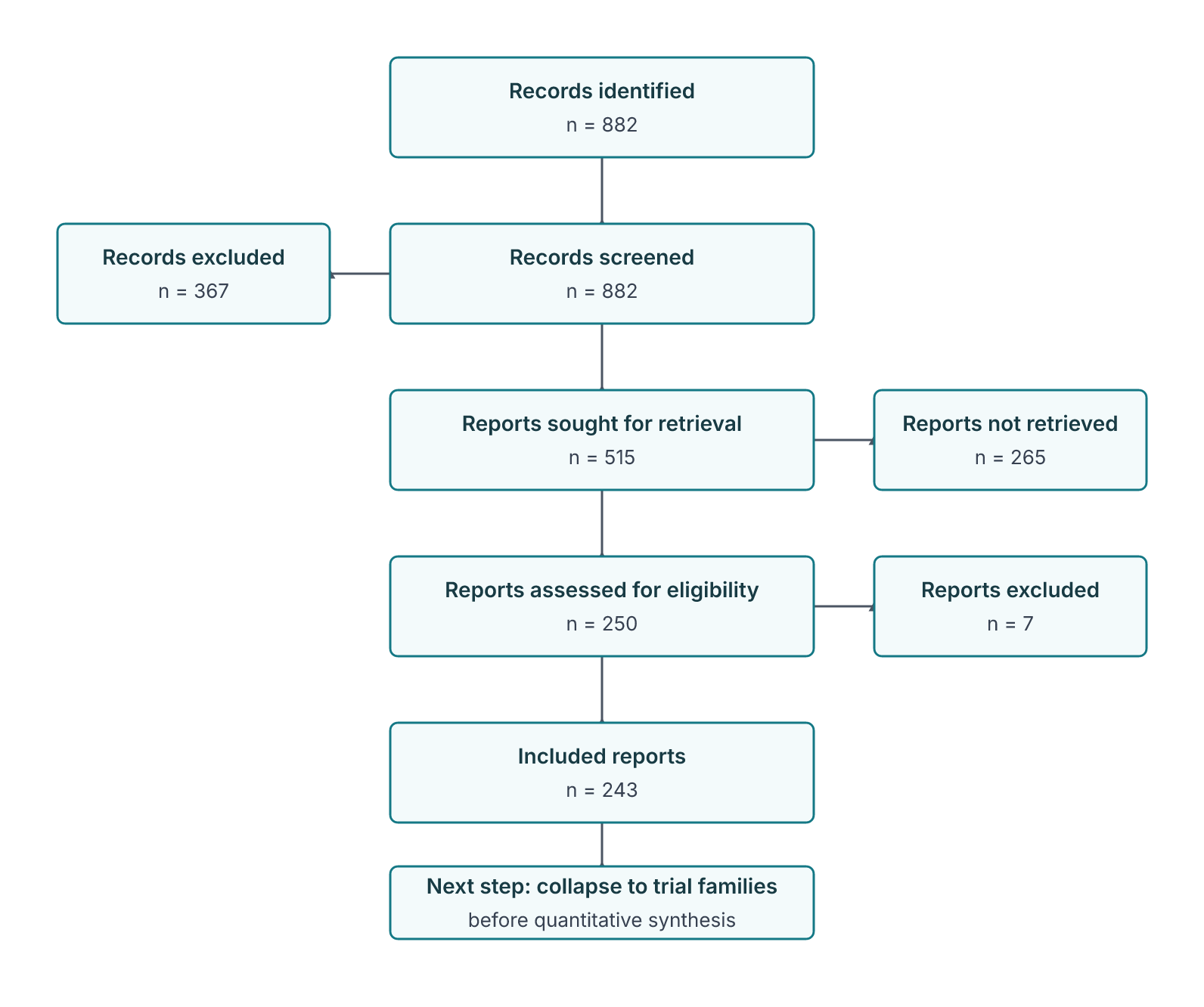
Slika 1. Dijagram tijeka za dovršeni pregled. Analiza će zadržati 265 izvješća koja nisu dohvaćena kao zasebnu PRISMA kategoriju umjesto da ih tretira kao neprimjenjiva.
Metode i hijerarhija dokaza
Dovršeni pregled analizirao je 882 zapisa, zatražio 515 izvješća za dohvaćanje i zadržao 243 izvješća nakon pregleda cjelovitog teksta. PRISMA slika odvaja nedohvaćene zapise od isključenja na temelju prihvatljivosti. Prije nego što se kvantitativni zaključci finaliziraju, višestruka izvješća iz iste randomizirane kohorte moraju se spojiti u obitelj kliničkih ispitivanja; tablica s 50 redaka u nastavku stoga predstavlja mapu dokaza na razini tvari, a ne meta-analizu.[2]
Hijerarhija je sljedeća: izravni autonomni dokazi (kontrolirani RMSSD, HF-HRV, PEP, RSA ili usporedive srčano-vagalne mjere); neizravna fiziologija stresa (kortizol, alfa-amilaza, GSR, kateholamini); zatim ishodi koje prijavljuju pacijenti. Krajnja točka niže razine ne može utvrditi parasimpatičku aktivaciju. U ispitivanju s bademima, snaga HF-a izričito se tumači kao mjera parasimpatičke respiratorne modulacije, dok LF/HF ima osporeno fiziološko značenje.[1]
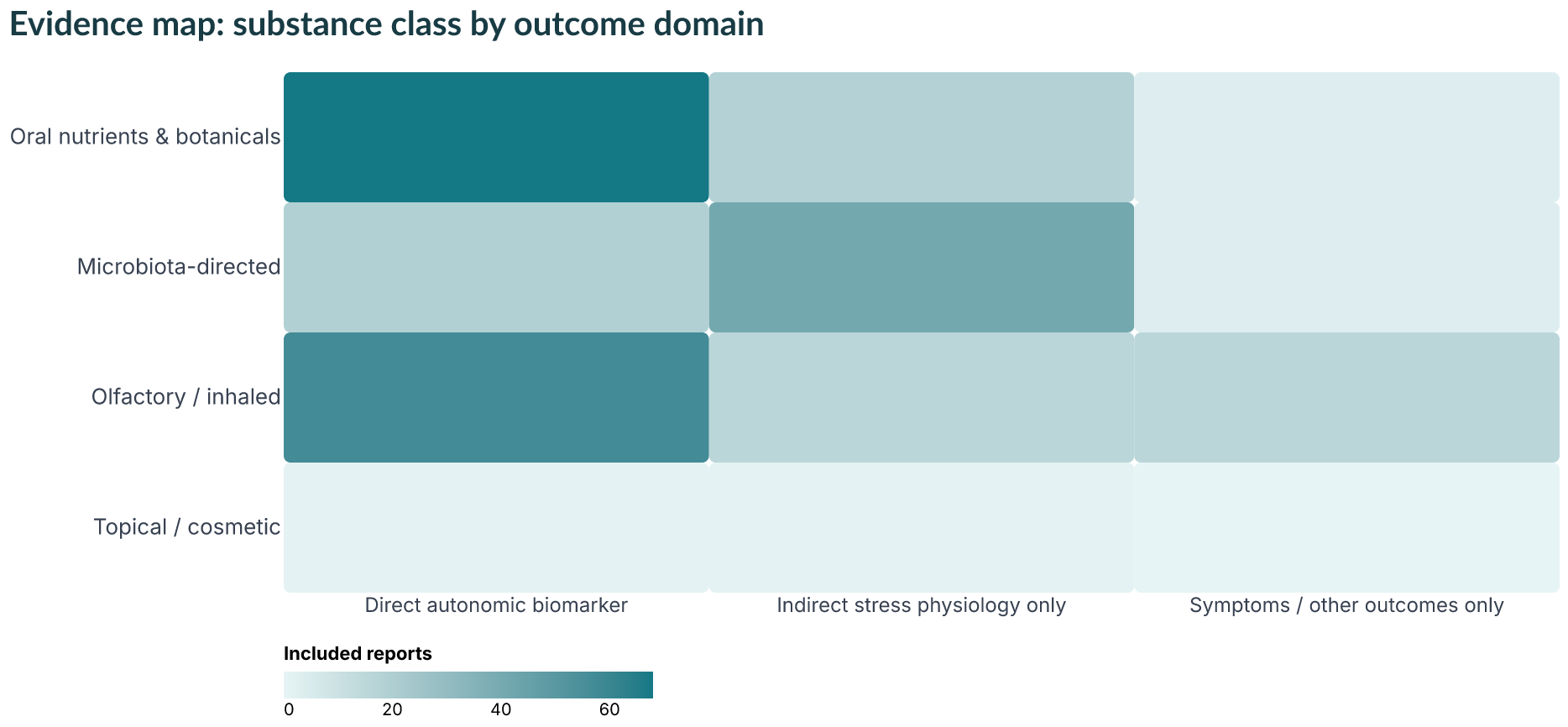
Slika 2. Karta na razini izvješća dovršenog pregleda. Svako uključeno izvješće kodirano je na temelju svog ekstrahiranog puta i identiteta sastojka te prema tome je li izvijestilo o izravnom autonomnom biomarkeru, samo neizravnoj fiziologiji stresa ili samo simptomima/ostalim ishodima. Vrijednosti ćelija su brojevi izvješća, a ne smjer učinka, sigurnost ili broj neovisnih ispitivanja; deduplikacija obitelji ispitivanja prethodit će kvantitativnoj sintezi.
Kandidacijski mehanički okvir
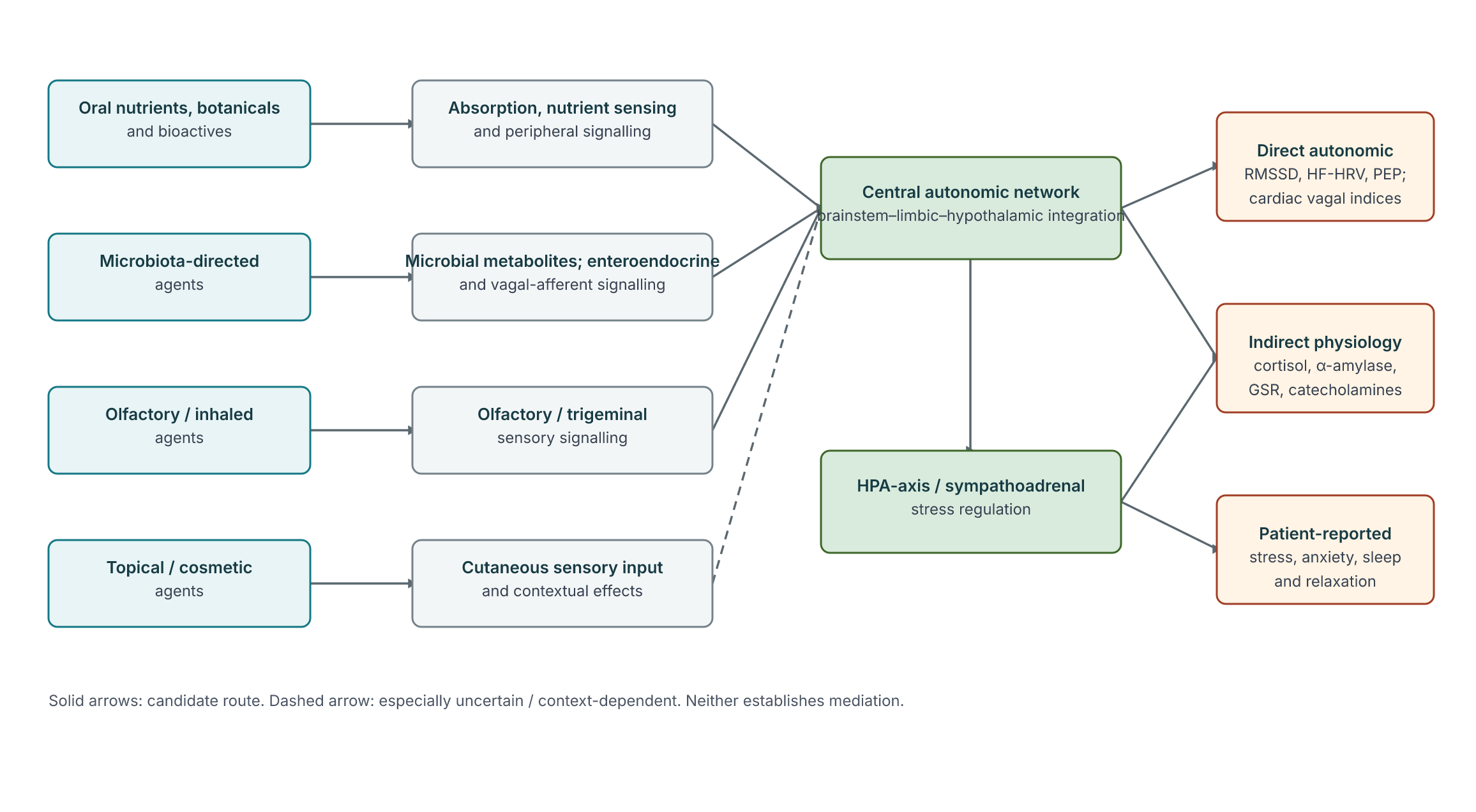
Slika 3. Konceptualni okvir za pregled. Strelice označavaju biološki vjerojatne kandidate za puteve, a ne dokazanu medijaciju u uključenim ispitivanjima. Rad će razlikovati mehaničku osnovu od kliničkih dokaza promjena u autonomnim biomarkerima ili biomarkerima stresa.
Dijagram je namjerno okvir kandidacijskih puteva. Kontrolirana ispitivanja mogu pokazati promjenu biomarkera, ali rijetko utvrđuju da ju je posredovao predloženi olfaktorni, vagalno-aferentni, imuno-metabolički put ili put HPA-osi. Na primjer, istraživači koji su proučavali bademe navode nekoliko mogućih objašnjenja povezanih s nutrijentima, vaskularnim sustavom, barorefleksom, glikemijom i stresom umjesto da identificiraju jedan mehanizam.[1]
Glavna mapa dokaza za 50 tvari
Pravilo tumačenja: „Izravno” znači da je najmanje jedno kontrolirano ljudsko izvješće procjenjivalo srčano-autonomnu mjeru; to ne znači ponovljenu učinkovitost. „Neizravno” znači da su pregledani dokazi na ljudima bili uglavnom neuroendokrini, elektrodermalni, EEG ili na razini simptoma. „Kandidacijski put” je mehanička hipoteza, a ne potvrđeni posrednik. EU status mora se provjeriti sastojak po sastojak i ne smije se pretvoriti u zdravstvenu tvrdnju vezanu uz autonomni sustav. Ovo pravilo klasifikacije slijedi hijerarhiju dokaza primijenjenu u ovom radu, umjesto da tvrdi odobrenje ili učinkovitost. Razlika između tumačenja HF/RMSSD i LF/HF temelji se na raspravi o mjerenju HRV-a u kontroliranom ispitivanju s bademima.[1]
| # | Tvar / standardizirani agens | Klasa / put | Kandidacijski put | Najviša razina ishoda | Stav o dokazima |
|---|---|---|---|---|---|
| 1 | Omega-3 EPA+DHA | Oralni nutrijent | Elektrofiziologija membrana; barorefleksna/srčana reaktivnost | Izravno | Kontekstualno specifičan izravan signal |
| 2 | Cijeli bademi | Oralna hrana | Hipoteze o obrascu nutrijenata, vaskularnom sustavu i barorefleksu | Izravno | Jedno kontrolirano izvješće o zadatku stresa utvrdilo je veću snagu HF-a u odnosu na kontrolnu skupinu; ostali indeksi nisu bili zahvaćeni.[1] |
| 3 | L-teanin | Oralna aminokiselina | Glutamatergična/GABAergična modulacija stresa | Neizravno | Neizravno / miješano |
| 4 | GABA | Oralna aminokiselina | Enterička i periferna signalizacija GABA-e | Izravno | Rani izravni dokazi |
| 5 | Taurin | Oralna aminokiselina | Osmoregulacija i autonomna modulacija | Neizravno | Neizravno / miješano |
| 6 | Glicin | Oralna aminokiselina | Inhibitorna neurotransmisija i fiziologija spavanja | Neizravno | Neizravno / miješano |
| 7 | Magnezij | Oralni mineral | Podražljivost i vaskularni tonus | Neizravno | Neizravno / miješano |
| 8 | Vitamin E | Oralni vitamin | Oksidativni stres i vaskularni mehanizmi | Izravno | Ograničeni izravni dokazi |
| 9 | Vitamin C | Oralni vitamin | Redoks i modulacija stresa HPA-osi | Neizravno | Neizravno / miješano |
| 10 | Prehrambeni nitrat / cikla | Oralni bioaktivni sastojak hrane | Dušikov oksid i barorefleksni putevi | Izravno | Rani izravni dokazi |
| 11 | Sok od lubenice | Oralni bioaktivni sastojak hrane | Signalizacija citrulin–NO | Izravno | Rani izravni dokazi |
| 12 | Alfa-laktoalbumin / hidrolizat triptofana | Oralni peptid | Put serotonergičkog prekursor | Izravno | Rani izravni dokazi |
| 13 | Laktoferin | Oralni peptid | Neuroimuna signalizacija i signalizacija osi stresa | Neizravno | Neizravno / miješano |
| 14 | Hidrolizat alfa-s1-kazeina (Lactium) | Oralni peptid | Bioaktivni peptid / hipoteza o GABA-A | Neizravno | Neizravno / miješano |
| 15 | Fosfatidilserin + fosfatidna kiselina | Oralni fosfolipid | Reaktivnost HPA-osi | Neizravno | Neizravni signal fiziologije stresa |
| 16 | Ekstrakt Ašvagande | Oralna biljna tvar | Hipoteza o HPA-osi i prilagodbi na stres | Neizravno | Neizravno / miješano |
| 17 | Ružičasta rodiola (Rhodiola rosea) | Oralna biljna tvar | Prilagodba na stres / monoaminergička hipoteza | Neizravno | Neizravno / miješano |
| 18 | Sveti bosiljak | Oralna biljna tvar | Hipoteza o prilagodbi na stres | Neizravno | Neizravno / miješano |
| 19 | Matičnjak | Oralna biljna tvar | GABAergična/kolinergična hipoteza | Neizravno | Neizravno / miješano |
| 20 | Kora magnolije | Oralna biljna tvar | Hipoteza o GABA-A i HPA-osi | Neizravno | Neizravno / miješano |
| 21 | Šafran | Oralna biljna tvar | Monoaminergička hipoteza i hipoteza o HPA-osi | Neizravno | Neizravno / miješano |
| 22 | Ekstrakt maquia | Oralni polifenol | Redoks / endotelna hipoteza | Izravno | Rani izravni dokazi |
| 23 | Ekstrakt šparoga tretiran enzimima | Oralna biljna tvar | Hipoteza o osi stresa | Neizravno | Neizravno / miješano |
| 24 | Acanthopanax senticosus | Oralna biljna tvar | Prilagodba na stres i srčano-autonomna hipoteza | Izravno | Rani izravni dokazi |
| 25 | L-karnitin | Oralni nutrijent | Mitochondrijalni i srčani metabolizam | Izravno | Prijavljen štetan izravan signal |
| 26 | Lactobacillus gasseri CP2305 (toplinski obrađen) | Postbiotik | Osovina crijeva-mozak / enteroendokrina-vagalna hipoteza | Izravno | Akutni izravan signal |
| 27 | Lactobacillus casei Shirota | Probiotik | Put mikrobiota-imunitet-HPA | Neizravno | Neizravno / miješano |
| 28 | Lactiplantibacillus plantarum PS128 | Probiotik | Mikrobiotsko-neuroendokrini put | Neizravno | Neizravno / miješano |
| 29 | Lactiplantibacillus plantarum P8 | Probiotik | Put mikrobiota-os stresa | Neizravno | Neizravno / miješano |
| 30 | Bifidobacterium longum 1714 | Probiotik | Osovina crijeva-mozak i put reaktivnosti na stres | Izravno | Rani izravni dokazi |
| 31 | Bifidobacterium longum NCC3001 | Probiotik | Osovina crijeva-mozak / imuni put | Neizravno | Neizravno / miješano |
| 32 | Lactobacillus helveticus R0052 + B. longum R0175 | Probiotik | Mikrobiotsko-HPA put | Neizravno | Neizravno / miješano |
| 33 | OMNi-BiOTiC STRESS Repair | Probiotik s više sojeva | Mikrobiotsko-autonomni put | Izravno | Izravan signal s ograničenom populacijom |
| 34 | Saccharomyces boulardii CNCM I-1079 | Probiotski kvasac | Mikrobiota-fiziologija stresa | Neizravno | Neizravno / miješano |
| 35 | Inulin | Prebiotik | SCFA i enteroendokrina signalizacija | Neizravno | Neizravno / miješano |
| 36 | Galakto-oligosaharidi (GOS) | Prebiotik | SCFA i mikrobiotsko-HPA put | Neizravno | Neizravno / miješano |
| 37 | Natrijev butirat | Postbiotik / SCFA | FFAR i enteroendokrina signalizacija | Neizravno | Neizravno / miješano |
| 38 | Eterično ulje bergamota | Olfaktorno | Olfaktorno-limbičko-autonomni put | Izravno | Izravno, ali sa senzornom zaslijepljenošću |
| 39 | Eterično ulje lavande | Olfaktorno / lokalno | Olfaktorno-limbički ili kožni senzorni put | Izravno | Malo / ovisno o kontekstu |
| 40 | Linalol | Olfaktorno | Olfaktorno-limbički put | Izravno | Rani izravni dokazi |
| 41 | Linalil acetat | Olfaktorno | Olfaktorno-limbički put | Neizravno | Neizravno / miješano |
| 42 | β-kariofilen | Olfaktorno | Olfaktorno senzorna i CB2 hipoteza | Izravno | Rani izravni dokazi |
| 43 | Citral | Olfaktorno | Olfaktorno senzorni put | Izravno | Rani izravni dokazi |
| 44 | Eterično ulje naranče | Olfaktorno | Olfaktorno-limbički put | Izravno | Rani izravni dokazi |
| 45 | Eterično ulje yuzua | Olfaktorno | Olfaktorno-limbički put | Izravno | Rani izravni dokazi |
| 46 | Eterično ulje nerolija | Olfaktorno | Olfaktorno-limbički put | Neizravno | Neizravno / miješano |
| 47 | Eterično ulje ylang-ylanga | Olfaktorno | Olfaktorno-limbički put | Neizravno | Neizravno / miješano |
| 48 | Cedar / cedrol | Olfaktorno | Olfaktorno senzorni put | Izravno | Rani izravni dokazi |
| 49 | Fitoncidni terpeni | Olfaktorno | Olfaktorno senzorni put | Izravno | Rani izravni dokazi |
| 50 | Eterično ulje ruže | Olfaktorno | Olfaktorno-limbički put | Neizravno | Neizravno / miješano |
Tumačenje ponderirano dokazima
Tablica namjerno nije rang-lista proizvoda. Najvažnije pitanje za svakog kandidata jest ponavlja li se promjena RMSSD-a, HF-HRV-a, RSA-e ili PEP-a dobivena usporedbom s placebom ili kontrolom u populaciji i kontekstu relevantnima za namjeravanu uporabu. Izravni dokazi koji se pojavljuju u jednoj maloj, akutnoj senzornoj studiji ili u formulaciji s više sastojaka ne smiju se prenositi u potrošačke tvrdnje o autonomnom živčanom sustavu. Sljedeći je korak u izradi rukopisa revizija obitelji kliničkih ispitivanja, nakon čega slijedi ekstrakcija veličine učinka samo u slučajevima kada izvorna izvješća sadrže kompatibilne srednje vrijednosti, mjere raspršenja, vremenske točke i komparatore. Potreba za uklanjanjem duplikata dokaza na razini izvješća prije kvantitativne sinteze eksplicitno je navedena u revizijskom protjeku pregleda.[2]
Podaci iz izvornog dokumenta