编辑文章开放获取专家审核Precision Microbiome & Gut-Brain Axis

Autonomic Stress Modulation by Nutraceutical, Microbiota-Directed, and Sensory Agents: An Evidence Synthesis with Pathway Map

发布日期: 24 August 2026·Olympia R&D Bulletin·Permalink: olympiabiosciences.com/rd-hub/autonomic-stress-microbiome-hrv/·2 引用来源·≈ 6 分钟阅读
Autonomic Stress Modulation by Nutraceutical, Microbiota-Directed, and Sensory Agents: An Evidence Synthesis with Pathway Map — Precision Microbiome & Gut-Brain Axis scientific visualization

行业挑战

Formulating nutraceuticals for reliable and context-specific autonomic stress modulation, particularly through gut-brain axis pathways, is challenging due to the variability in cardiac-vagal indices and the lack of robust, direct evidence for broad 'parasympathetic activation' claims.

Olympia AI 验证解决方案

Olympia Biosciences leverages advanced evidence synthesis and AI-driven pathway mapping to precisely identify and validate nutraceutical, microbiota-directed, and sensory agents for targeted autonomic stress modulation, enhancing gut-brain axis interventions and ensuring formulation efficacy.

💬非专业人士?💬 获取通俗易懂的摘要

通俗解读

Developing nutritional products that reliably reduce stress by influencing the gut-brain connection is challenging. This is because how people react to stress varies greatly, and claims about generally boosting the body's natural calming system often lack strong, direct proof. A major review of 50 different substances (like certain foods or supplements) found that none can be labeled a proven, all-purpose "calming activator." Instead, tools like heart rate variability, which measures the subtle changes in our heartbeat, show effects that are specific to certain situations rather than a broad calming of the entire system. This means understanding the exact conditions under which these substances might help manage stress is crucial.

Olympia 已拥有直接针对该研究领域的配方或技术。

联系我们 →

Autonomic stress modulation by nutraceutical, microbiota-directed and sensory agents

A PRISMA-aligned evidence synthesis with a 50-substance pathway map

No substance in this evidence base should be described as a proven, general-purpose “parasympathetic activator.” HRV is an indirect measure of cardiac autonomic regulation.[1] The review framework labels cardiac-vagal indices, stress physiology, and symptom scores as separate outcome tiers. In the clearest dietary RCT located, almonds increased high-frequency HRV during a mental-stress task but not other HRV indices, illustrating why the review treats signals as context-specific rather than as global vagal activation.[1]

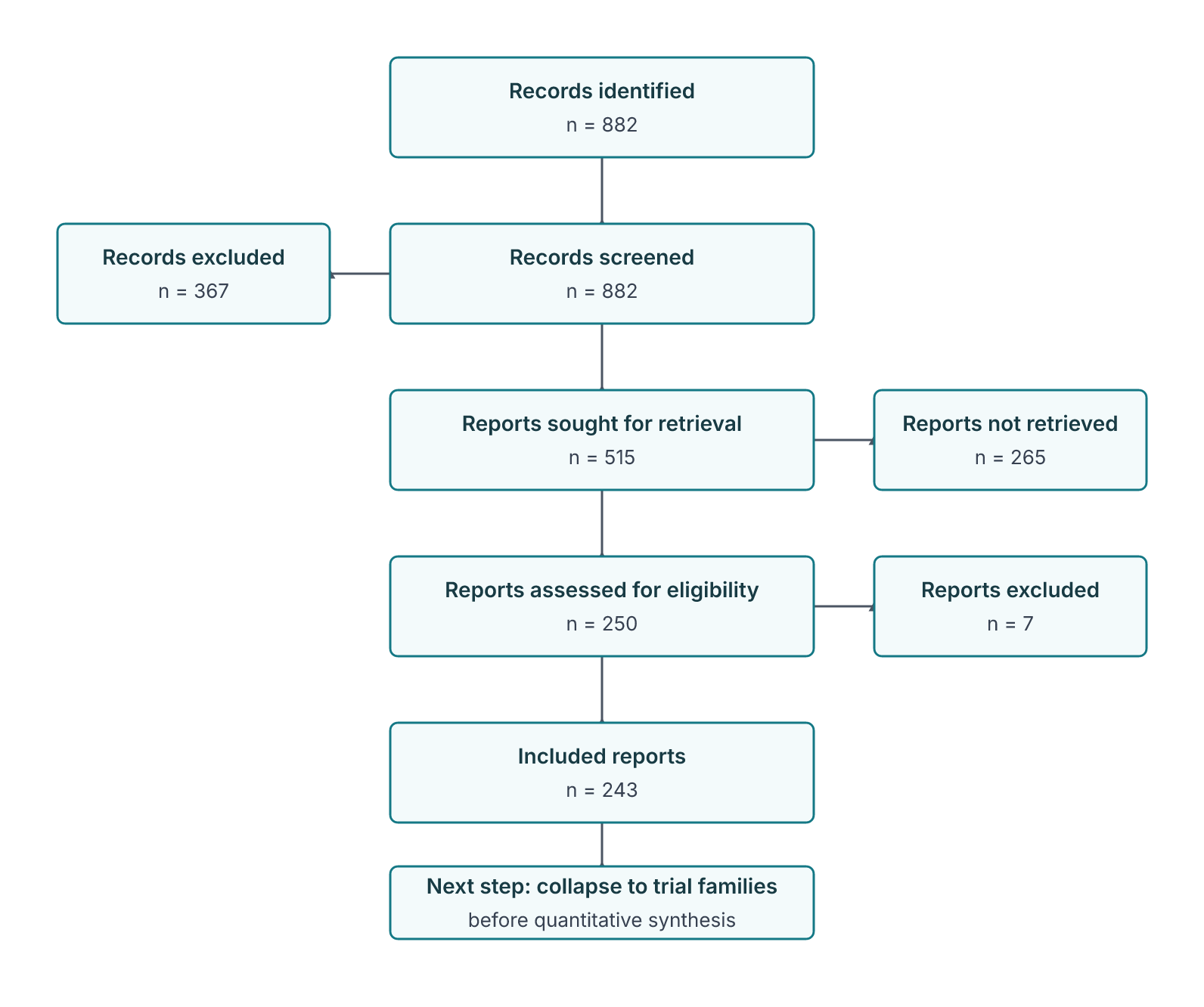
Figure 1. Flow diagram for the completed review. The analysis will retain the 265 reports not retrieved as a distinct PRISMA category rather than treating them as ineligible.

Methods and evidence hierarchy

The completed review screened 882 records, sought 515 reports for retrieval, and retained 243 reports after full-text screening. The PRISMA figure keeps non-retrieval separate from eligibility exclusions. Before quantitative conclusions are finalised, multiple reports from the same randomised cohort must be collapsed into a trial family; the 50-row table below is therefore a substance-level evidence map, not a meta-analysis.[2]

The hierarchy is: direct autonomic evidence (controlled RMSSD, HF-HRV, PEP, RSA or comparable cardiac-vagal measures); indirect stress physiology (cortisol, alpha-amylase, GSR, catecholamines); then patient-reported outcomes. A lower-tier endpoint cannot establish parasympathetic activation. In the almond trial, HF power is explicitly interpreted as a parasympathetic respiratory-modulation measure, whereas LF/HF has contested physiological meaning.[1]

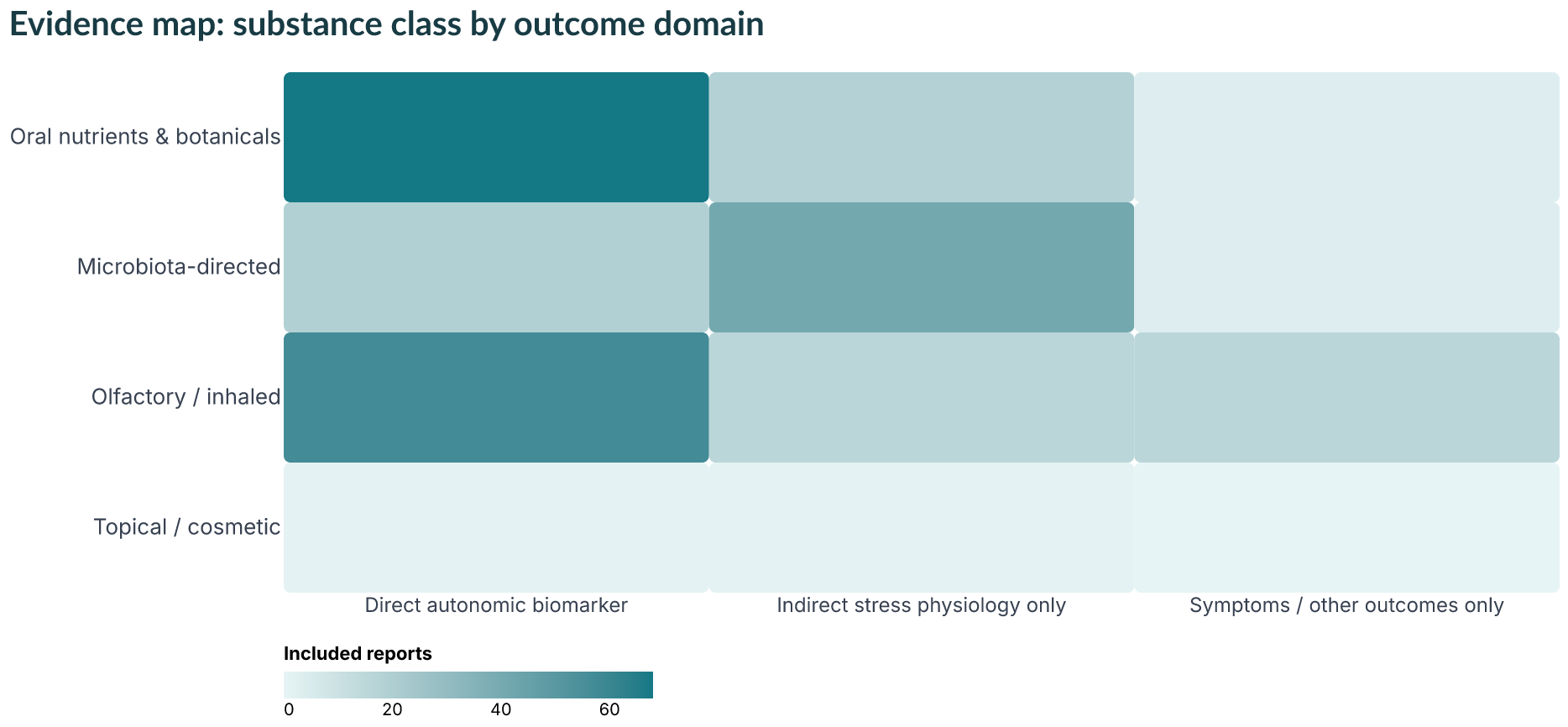
Figure 2. Report-level map of the completed review. Each included report was coded from its extracted route and ingredient identity and by whether it reported a direct autonomic biomarker, indirect stress physiology only, or symptoms/other outcomes only. Cell values are report counts, not effect direction, certainty, or independent trial counts; trial-family deduplication will precede quantitative synthesis.

Candidate mechanistic framework

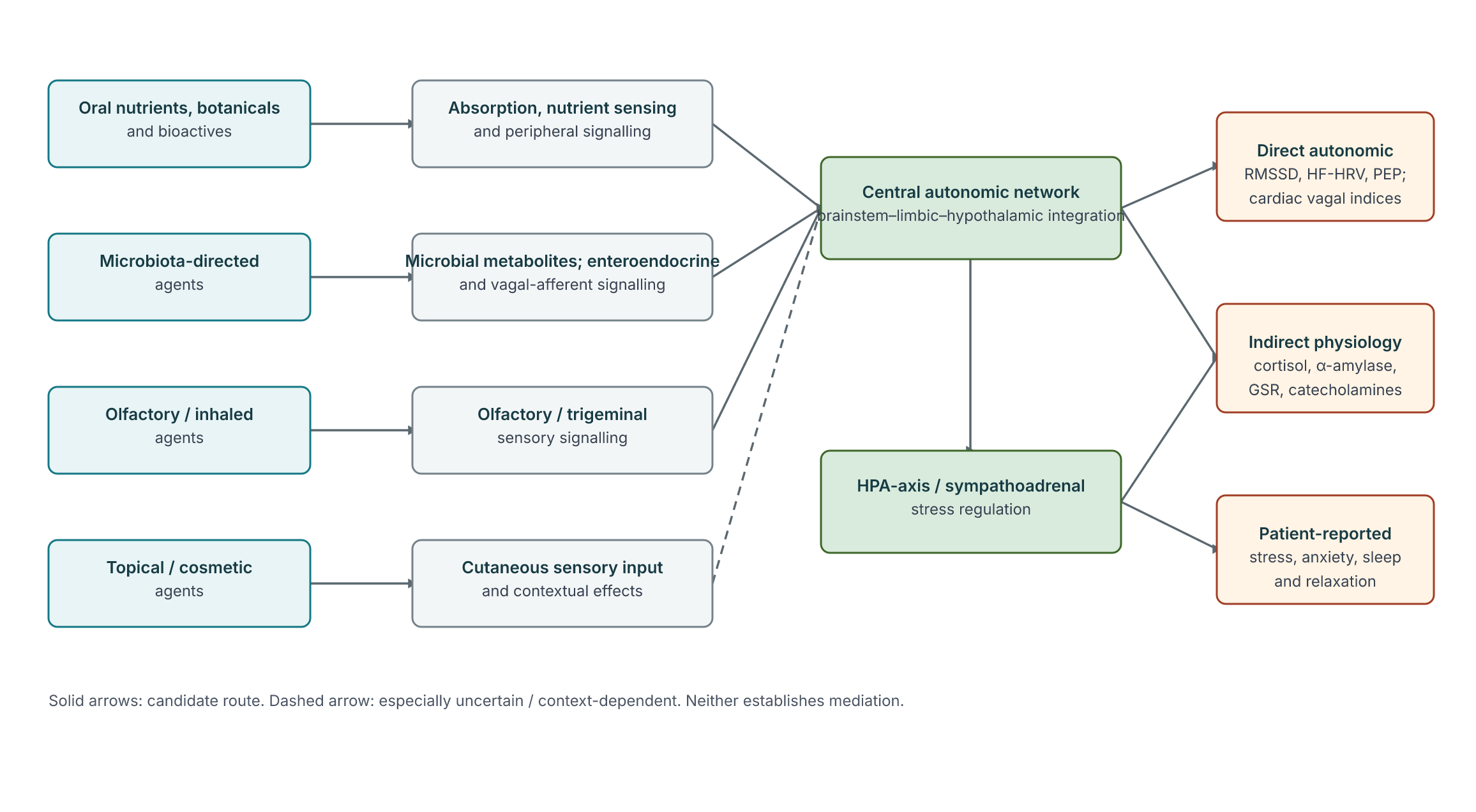
Figure 3. Conceptual framework for the review. Arrows denote biologically plausible candidate routes, not demonstrated mediation in the included trials. The paper will distinguish mechanistic rationale from clinical evidence of changes in autonomic or stress biomarkers.

The diagram is intentionally a candidate-pathway framework. Controlled trials can demonstrate a biomarker change but rarely establish that a proposed olfactory, vagal-afferent, immune-metabolic, or HPA-axis route mediated it. For example, the almond investigators list several possible nutrient, vascular, baroreflex, glycaemic, and stress-related explanations rather than identifying one mechanism.[1]

Master 50-substance evidence map

Interpretation rule: “Direct” means that at least one controlled human report evaluated a cardiac-autonomic measure; it does not mean replicated efficacy. “Indirect” means the reviewed human evidence was chiefly neuroendocrine, electrodermal, EEG, or symptom-level. “Candidate pathway” is a mechanistic hypothesis, not a confirmed mediator. EU status must be verified ingredient-by-ingredient and must not be converted into an autonomic health claim. This classification rule follows the evidence hierarchy applied in this paper rather than asserting authorisation or efficacy. The distinction between HF/RMSSD and LF/HF interpretation is grounded in the HRV measurement discussion of the controlled almond trial.[1]

#Substance / standardized agentClass / routeCandidate pathwayHighest outcome tierEvidence stance
1Omega-3 EPA+DHAOral nutrientMembrane electrophysiology; baroreflex/cardiac responsivenessDirectContext-specific direct signal
2Whole almondsOral foodNutrient-pattern, vascular and baroreflex hypothesesDirectOne controlled stress-task report found higher HF power versus control; other indices were unaffected.[1]
3L-theanineOral amino acidGlutamatergic/GABAergic stress modulationIndirectIndirect / mixed
4GABAOral amino acidEnteric and peripheral GABA signallingDirectEarly direct evidence
5TaurineOral amino acidOsmoregulation and autonomic modulationIndirectIndirect / mixed
6GlycineOral amino acidInhibitory neurotransmission and sleep physiologyIndirectIndirect / mixed
7MagnesiumOral mineralExcitability and vascular toneIndirectIndirect / mixed
8Vitamin EOral vitaminOxidative-stress and vascular mechanismsDirectLimited direct evidence
9Vitamin COral vitaminRedox and HPA-stress modulationIndirectIndirect / mixed
10Dietary nitrate / beetrootOral food bioactiveNitric oxide and baroreflex pathwaysDirectEarly direct evidence
11Watermelon juiceOral food bioactiveCitrulline–NO signallingDirectEarly direct evidence
12Alpha-lactalbumin / tryptophan hydrolysateOral peptideSerotonergic precursor pathwayDirectEarly direct evidence
13LactoferrinOral peptideNeuroimmune and stress-axis signallingIndirectIndirect / mixed
14Alpha-s1-casein hydrolysate (Lactium)Oral peptideBioactive peptide / GABA-A hypothesisIndirectIndirect / mixed
15Phosphatidylserine + phosphatidic acidOral phospholipidHPA-axis reactivityIndirectIndirect stress-physiology signal
16Ashwagandha extractOral botanicalHPA-axis and stress-adaptation hypothesisIndirectIndirect / mixed
17Rhodiola roseaOral botanicalStress-adaptation / monoaminergic hypothesisIndirectIndirect / mixed
18Holy basilOral botanicalStress-adaptation hypothesisIndirectIndirect / mixed
19Lemon balmOral botanicalGABAergic/cholinergic hypothesisIndirectIndirect / mixed
20Magnolia barkOral botanicalGABA-A and HPA-axis hypothesisIndirectIndirect / mixed
21SaffronOral botanicalMonoaminergic and HPA-axis hypothesisIndirectIndirect / mixed
22Maqui extractOral polyphenolRedox / endothelial hypothesisDirectEarly direct evidence
23Enzyme-treated asparagus extractOral botanicalStress-axis hypothesisIndirectIndirect / mixed
24Acanthopanax senticosusOral botanicalStress-adaptation and cardiac-autonomic hypothesisDirectEarly direct evidence
25L-carnitineOral nutrientMitochondrial and cardiac metabolismDirectAdverse direct signal reported
26Lactobacillus gasseri CP2305 (heat-treated)PostbioticGut–brain / enteroendocrine–vagal hypothesisDirectAcute direct signal
27Lactobacillus casei ShirotaProbioticMicrobiota–immune–HPA pathwayIndirectIndirect / mixed
28Lactiplantibacillus plantarum PS128ProbioticMicrobiota–neuroendocrine pathwayIndirectIndirect / mixed
29Lactiplantibacillus plantarum P8ProbioticMicrobiota–stress-axis pathwayIndirectIndirect / mixed
30Bifidobacterium longum 1714ProbioticGut–brain and stress-reactivity pathwayDirectEarly direct evidence
31Bifidobacterium longum NCC3001ProbioticGut–brain / immune pathwayIndirectIndirect / mixed
32Lactobacillus helveticus R0052 + B. longum R0175ProbioticMicrobiota–HPA pathwayIndirectIndirect / mixed
33OMNi-BiOTiC STRESS RepairMulti-strain probioticMicrobiota–autonomic pathwayDirectPopulation-limited direct signal
34Saccharomyces boulardii CNCM I-1079Probiotic yeastMicrobiota–stress physiologyIndirectIndirect / mixed
35InulinPrebioticSCFA and enteroendocrine signallingIndirectIndirect / mixed
36Galacto-oligosaccharides (GOS)PrebioticSCFA and microbiota–HPA pathwayIndirectIndirect / mixed
37Sodium butyratePostbiotic / SCFAFFAR and enteroendocrine signallingIndirectIndirect / mixed
38Bergamot essential oilOlfactoryOlfactory–limbic–autonomic pathwayDirectDirect but sensory-unblinded
39Lavender essential oilOlfactory / topicalOlfactory–limbic or cutaneous sensory pathwayDirectSmall / context-dependent
40LinaloolOlfactoryOlfactory–limbic pathwayDirectEarly direct evidence
41Linalyl acetateOlfactoryOlfactory–limbic pathwayIndirectIndirect / mixed
42β-CaryophylleneOlfactoryOlfactory sensory and CB2 hypothesisDirectEarly direct evidence
43CitralOlfactoryOlfactory sensory pathwayDirectEarly direct evidence
44Orange essential oilOlfactoryOlfactory–limbic pathwayDirectEarly direct evidence
45Yuzu essential oilOlfactoryOlfactory–limbic pathwayDirectEarly direct evidence
46Neroli essential oilOlfactoryOlfactory–limbic pathwayIndirectIndirect / mixed
47Ylang-ylang essential oilOlfactoryOlfactory–limbic pathwayIndirectIndirect / mixed
48Cedarwood / cedrolOlfactoryOlfactory sensory pathwayDirectEarly direct evidence
49Phytoncide terpenesOlfactoryOlfactory sensory pathwayDirectEarly direct evidence
50Rose essential oilOlfactoryOlfactory–limbic pathwayIndirectIndirect / mixed

Evidence-weighted interpretation

The table is deliberately not a product-ranking list. The strongest question for each candidate is whether a placebo- or control-comparative change in RMSSD, HF-HRV, RSA or PEP is replicated in a population and context relevant to intended use. The direct evidence that appears in one small, acute sensory study or in a multi-ingredient formulation should not be transported into a consumer-level autonomic claim. The next manuscript step is a trial-family audit, followed by effect-size extraction only where the underlying reports supply compatible means, dispersions, timepoints, and comparators. The need to deduplicate report-level evidence before quantitative synthesis is explicit in the review-flow audit.[2]

作者贡献

O.B.: Conceptualization, Literature Review, Writing — Original Draft, Writing — Review & Editing. The author has read and approved the published version of the manuscript.

利益冲突

The author declares no conflict of interest. Olympia Biosciences™ operates exclusively as a Contract Development and Manufacturing Organization (CDMO) and does not manufacture or market consumer end-products in the subject areas discussed herein.

Olimpia Baranowska

Olimpia Baranowska

首席执行官兼科学总监 · 技术物理与应用数学工程硕士(抽象量子物理与有机微电子学)· 医学科学博士候选人(静脉学)

Founder of Olympia Biosciences™ (IOC Ltd.) · ISO 27001 Lead Auditor · Specialising in pharmaceutical-grade CDMO formulation, liposomal & nanoparticle delivery systems, and clinical nutrition.

专有知识产权

对该技术感兴趣?

有意基于此项科学成果开发产品?我们与制药公司、长寿诊所及私募股权支持的品牌合作,将专有研发成果转化为市场就绪的配方。

部分精选技术可按类别向单一战略合作伙伴提供独家授权——请启动尽职调查以确认分配状态。

洽谈合作伙伴关系 →

全球科学与法律声明

  1. 1. 仅限 B2B 及教育用途. Olympia Biosciences 网站上发布的科学文献、研究见解及教育资料仅供学术参考及企业对企业(B2B)行业交流使用。其受众仅限于以专业 B2B 身份开展业务的医疗专业人士、药理学家、生物技术专家及品牌开发人员。

  2. 2. 无特定产品声明. Olympia Biosciences™ 仅作为 B2B 合同制造商运营。本文所讨论的研究、成分概况及生理机制均为通用学术概述。它们不涉及、背书或构成我司生产的任何特定商业膳食补充剂、医用食品或终端产品的授权营销健康声明。本页面内容不构成欧洲议会及理事会第 (EC) No 1924/2006 号条例所定义的健康声明。

  3. 3. 非医疗建议. 所提供内容不构成医疗建议、诊断、治疗或临床推荐,亦不能替代与合格医疗保健提供者的咨询。所有发布的科学资料均代表基于同行评审研究的通用学术概述,且仅应在 B2B 配方及研发背景下进行解读。

  4. 4. 监管状态与客户责任. 尽管我们尊重并遵循全球卫生当局(包括 EFSA、FDA 及 EMA)的指导方针,但我们文章中讨论的前沿科学研究可能尚未经过这些机构的正式评估。在任何司法管辖区内,最终产品的合规性、标签准确性以及 B2C 营销声明的证实,均由品牌所有者承担全部法律责任。Olympia Biosciences™ 仅提供制造、配方及分析服务。 上述声明及原始数据未经美国食品药品监督管理局 (FDA)、欧洲食品安全局 (EFSA) 或澳大利亚药品管理局 (TGA) 评估。本文讨论的原料药 (APIs) 及配方并非旨在诊断、治疗、治愈或预防任何疾病。本页面内容不构成欧盟第 (EC) No 1924/2006 号条例或美国《膳食补充剂健康与教育法》(DSHEA) 所定义的健康声明。

编辑声明

Olympia Biosciences™ 是一家欧洲医药 CDMO,专注于定制化补充剂配方研发。我们不生产或调配处方药。本文作为我们 R&D Hub 的一部分发布,仅供教育参考。

我们的知识产权承诺

我们不拥有消费品牌,绝不与客户形成竞争关系。

Olympia Biosciences™ 开发的每一项配方均从零构建,并以完整的知识产权所有权移交给您。零利益冲突——由 ISO 27001 网络安全标准及严苛的 NDA 提供保障。

探索知识产权保护

引用

APA

Baranowska, O. (2026). Autonomic Stress Modulation by Nutraceutical, Microbiota-Directed, and Sensory Agents: An Evidence Synthesis with Pathway Map. Olympia R&D Bulletin. https://olympiabiosciences.com/rd-hub/autonomic-stress-microbiome-hrv/

Vancouver

Baranowska O. Autonomic Stress Modulation by Nutraceutical, Microbiota-Directed, and Sensory Agents: An Evidence Synthesis with Pathway Map. Olympia R&D Bulletin. 2026. Available from: https://olympiabiosciences.com/rd-hub/autonomic-stress-microbiome-hrv/

BibTeX
@article{Baranowska2026autonomi,
  author  = {Baranowska, Olimpia},
  title   = {Autonomic Stress Modulation by Nutraceutical, Microbiota-Directed, and Sensory Agents: An Evidence Synthesis with Pathway Map},
  journal = {Olympia R\&D Bulletin},
  year    = {2026},
  url     = {https://olympiabiosciences.com/rd-hub/autonomic-stress-microbiome-hrv/}
}

执行方案评审

Article

Autonomic Stress Modulation by Nutraceutical, Microbiota-Directed, and Sensory Agents: An Evidence Synthesis with Pathway Map

https://olympiabiosciences.com/rd-hub/autonomic-stress-microbiome-hrv/

1

先向 Olimpia 发送简要说明

在预约时段前,请告知 Olimpia 您希望讨论的文章。

2

打开高管分配日程表

提交授权背景后选择资质审核时段,以优先评估战略契合度。

打开高管分配日程表

表达对该技术的合作意向

我们将与您跟进许可或合作详情。

Article

Autonomic Stress Modulation by Nutraceutical, Microbiota-Directed, and Sensory Agents: An Evidence Synthesis with Pathway Map

绝无垃圾邮件。Olympia 将由专人审核您的意向。