Autonom stressmodulering med nutraceutiska, mikrobiotastyrda och sensoriska substanser
En PRISMA-anpassad evidenssyntes med en vägkarta för 50 substanser
Ingen substans i detta evidensunderlag bör beskrivas som en bevisad ”parasympatisk aktivator” för allmänna ändamål. HRV är ett indirekt mått på kardiell autonom reglering.[1] Granskningsramverket klassificerar kardiell-vagala index, stressfysiologi och symtompoäng som separata utfallsklasser. I den tydligaste kostrelaterade RCT som identifierades ökade mandlar högfrekvent HRV under en mental stresstestuppgift men inte andra HRV-index, vilket illustrerar varför granskningen behandlar signaler som kontextspecifika snarare än som global vagal aktivering.[1]
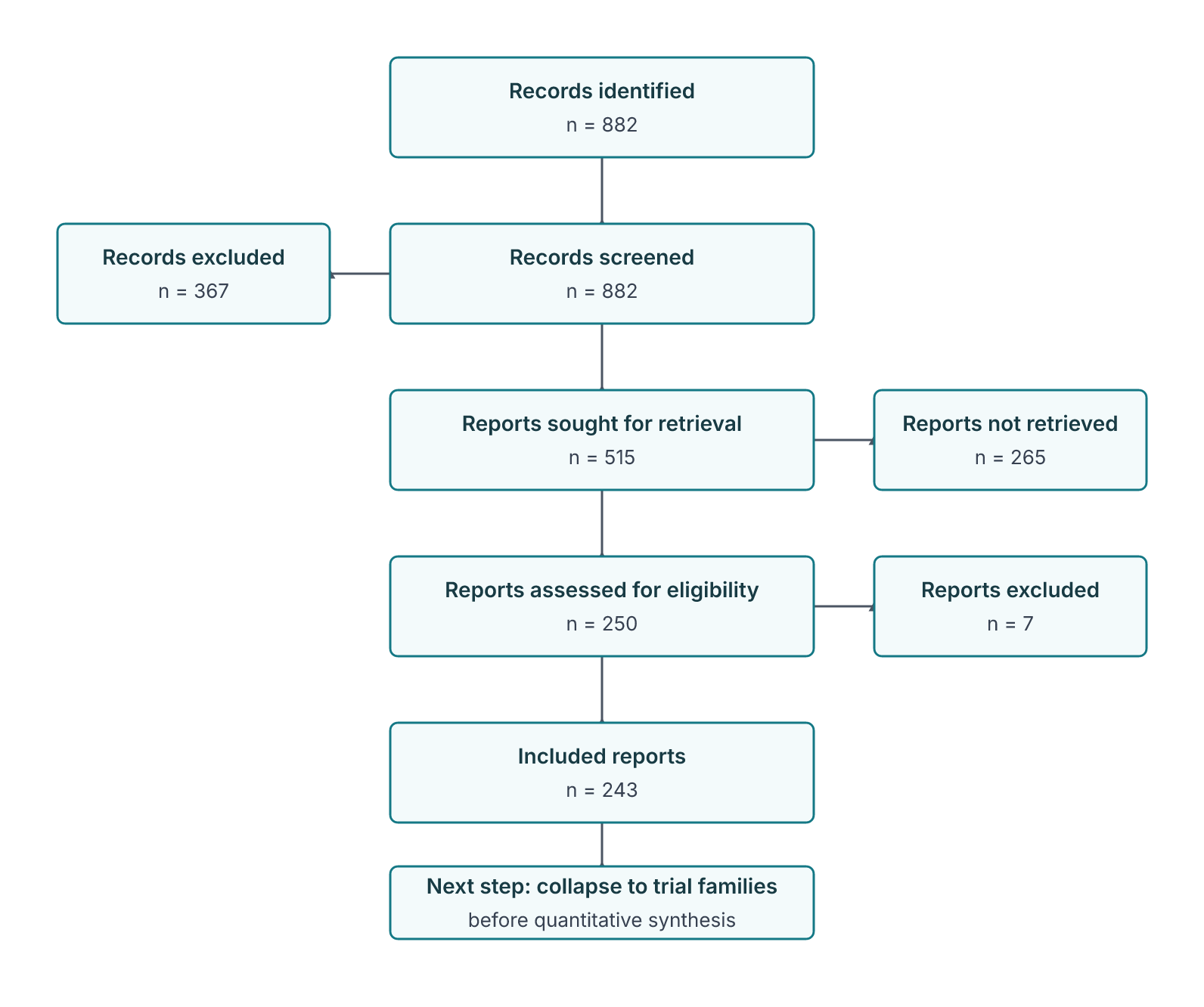
Figur 1. Flödesschema för den genomförda granskningen. Analysen kommer att behålla de 265 rapporter som inte hämtades som en separat PRISMA-kategori i stället för att behandla dem som icke-berättigade.
Metoder och evidenshierarki
Den genomförda granskningen sållade 882 journaler, efterfrågade 515 rapporter för inhämtning och behöll 243 rapporter efter fulltextsållning. PRISMA-figuren håller icke-inhämtning åtskild från behörighetsuteslutningar. Innan kvantitativa slutsatser fastställs måste flera rapporter från samma randomiserade kohort slås samman till en prövningsfamilj; tabellen med 50 rader nedan är därför en evidenskarta på substansnivå, inte en metaanalys.[2]
Hierarkin är: direkt autonom evidens (kontrollerad RMSSD, HF-HRV, PEP, RSA eller jämförbara kardiell-vagala mått); indirekt stressfysiologi (kortisol, alfa-amylas, GSR, katekolaminer); därefter patientrapporterade utfall. Ett utfall på lägre nivå kan inte fastställa parasympatisk aktivering. I mandelprövningen tolkas HF-effekten uttryckligen som ett parasympatiskt andningsmoduleringsmått, medan LF/HF har en omtvistad fysiologisk innebörd.[1]
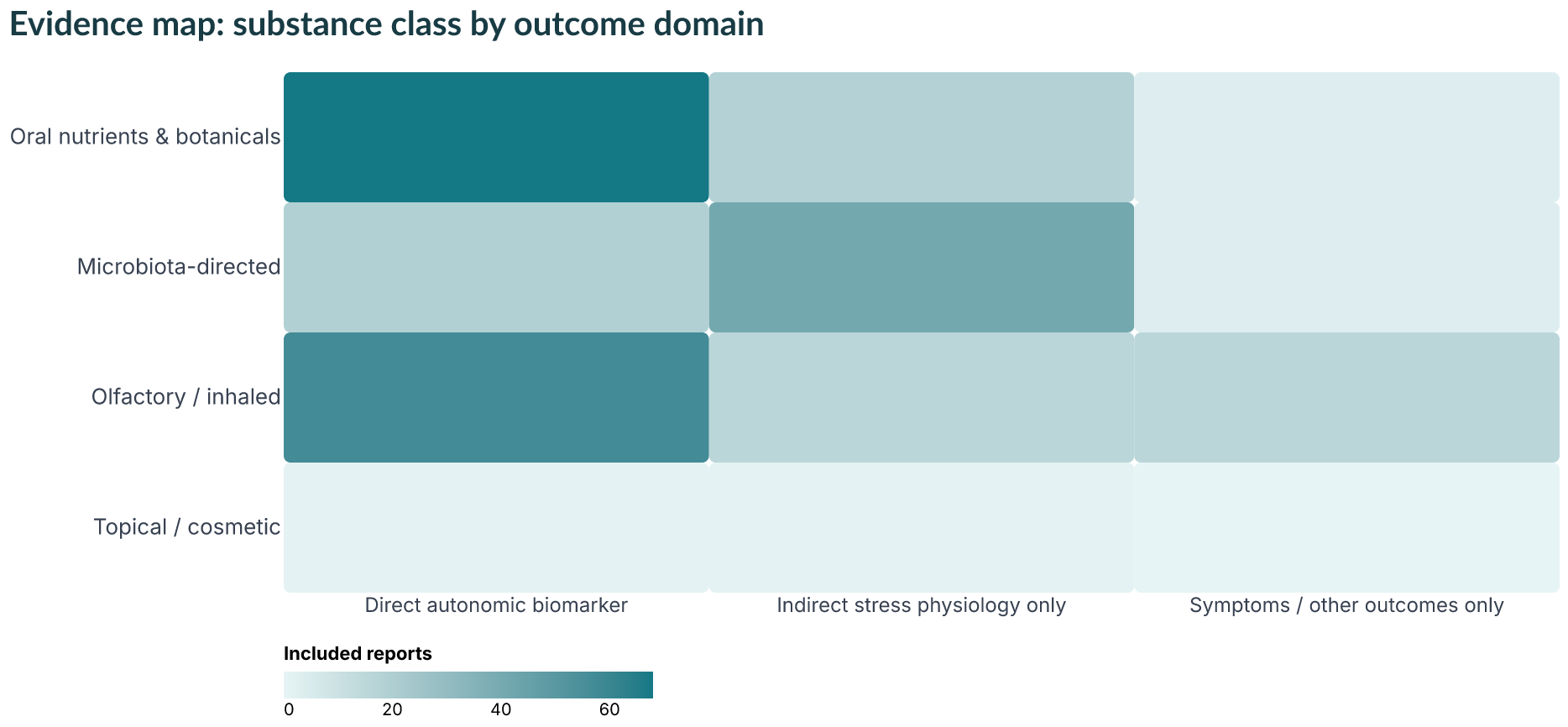
Figur 2. Rapportnivåkarta för den genomförda granskningen. Varje inkluderad rapport kodades utifrån sin extraherade rutt och ingrediensidentitet samt utifrån om den rapporterade en direkt autonom biomarkör, enbart indirekt stressfysiologi eller enbart symtom/andra utfall. Cellvärden är rapportantal, inte effektriktning, säkerhet eller oberoende prövningsantal; deduplicering av prövningsfamilj kommer att föregå kvantitativ syntes.
Kandidatmekanistiskt ramverk
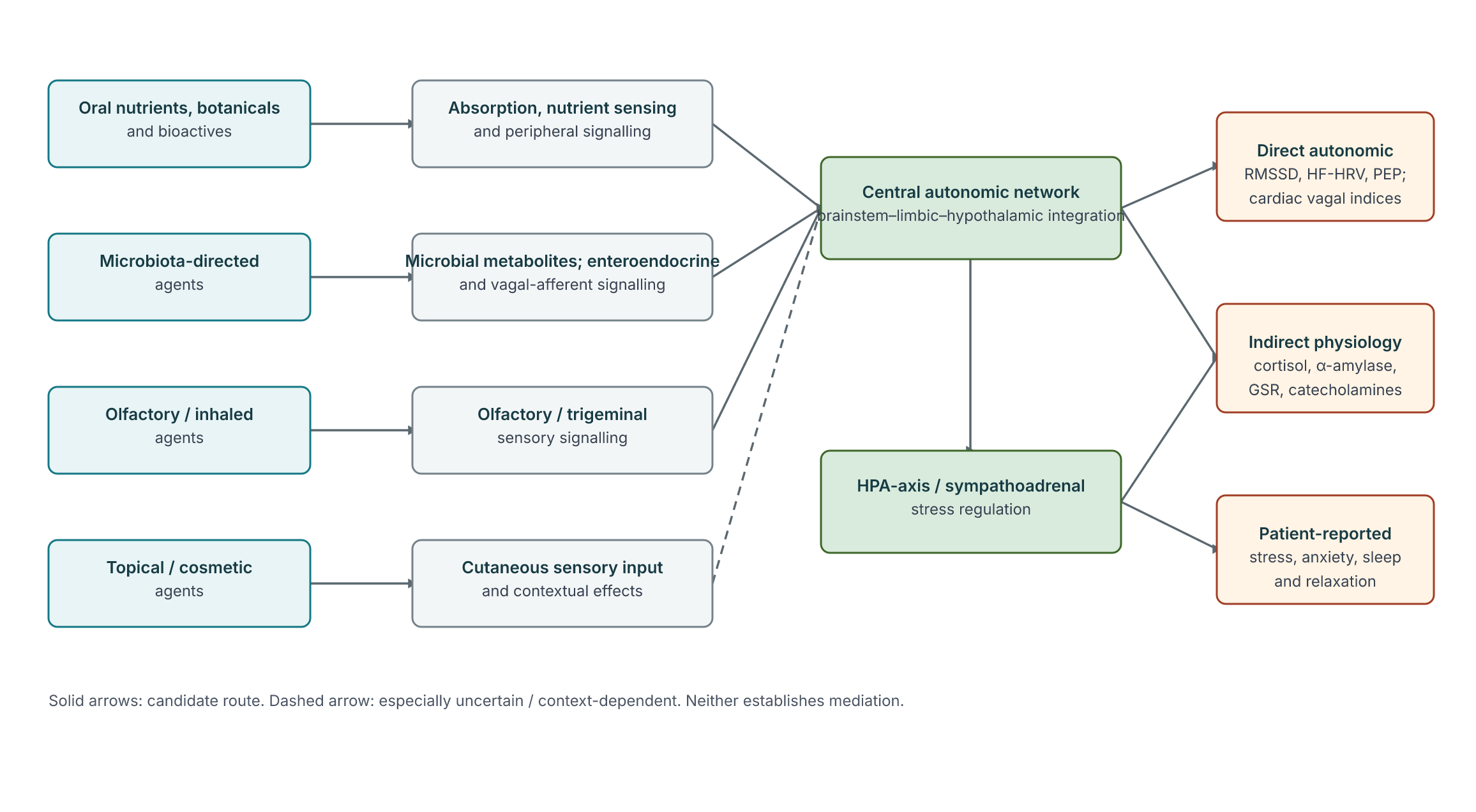
Figur 3. Konceptuellt ramverk för granskningen. Pilar anger biologiskt rimliga kandidatvägar, inte påvisad medling i de inkluderade prövningarna. Dokumentet kommer att skilja mekanistiskt rationale från kliniska evidens för förändringar i autonoma eller stressbiomarkörer.
Diagrammet är avsiktligt ett kandidatvägramverk. Kontrollerade prövningar kan påvisa en biomarkörförändring men fastställer sällan att en föreslagen lukt-, vagal-afferent, immun-metabolisk eller HPA-axelväg medierade den. Till exempel listar mandelforskarna flera möjliga näringsämnes-, vaskulära, baroreflex-, glykemiska och stressrelaterade förklaringar i stället för att identifiera en mekanism.[1]
Huvudevidenskarta med 50 substanser
Tolkningsregel: ”Direkt” innebär att minst en kontrollerad humanrapport utvärderade ett kardiellt autonomt mått; det innebär inte replikerad effekt. ”Indirekt” innebär att det granskade huminevidensen huvudsakligen var neuroendokrin, elektrodermal, EEG- eller symtomnivå. ”Kandidatväg” är en mekanistisk hypotes, inte en bekräftad mediator. EU-status måste verifieras ingrediens för ingrediens och får inte omvandlas till ett hälsopåstående om det autonoma systemet. Denna klassificeringsregel följer den evidenshierarki som tillämpas i detta dokument i stället för att hävda godkännande eller effekt. Skiljelinjen mellan tolkning av HF/RMSSD och LF/HF är grundad i diskussionen om HRV-mätning i den kontrollerade mandelprövningen.[1]
| # | Substans / standardiserat agens | Klass / rutt | Kandidatväg | Högsta utfallsklass | Evidenshållning |
|---|---|---|---|---|---|
| 1 | Omega-3 EPA+DHA | Oralt näringsämne | Membranelektrofysiologi; baroreflex/kardiell responsivitet | Direkt | Kontextspecifik direkt signal |
| 2 | Hela mandlar | Oral föda | Näringsmönster-, vaskulära och baroreflexhypoteser | Direkt | En kontrollerad stresstestrapport fann högre HF-effekt jämfört med kontroll; andra index var opåverkade.[1] |
| 3 | L-teanin | Oral aminosyra | Glutamaterg/GABAerg stressmodulering | Indirekt | Indirekt / blandad |
| 4 | GABA | Oral aminosyra | Enterisk och perifer GABA-signalering | Direkt | Tidig direkt evidens |
| 5 | Taurin | Oral aminosyra | Osmoreglering och autonom modulering | Indirekt | Indirekt / blandad |
| 6 | Glycin | Oral aminosyra | Inhiberande neurotransmission och sömnfysiologi | Indirekt | Indirekt / blandad |
| 7 | Magnesium | Oralt mineral | Excitabilitet och vaskulär tonus | Indirekt | Indirekt / blandad |
| 8 | Vitamin E | Oralt vitamin | Oxidativ stress- och vaskulära mekanismer | Direkt | Begränsad direkt evidens |
| 9 | Vitamin C | Oralt vitamin | Redox- och HPA-stressmodulering | Indirekt | Indirekt / blandad |
| 10 | Kostnitar / rödbeta | Oralt livsmedelsbiomolekyl | Kväveoxid- och baroreflexvägar | Direkt | Tidig direkt evidens |
| 11 | Vattenmelonjuice | Oralt livsmedelsbiomolekyl | Citrullin-NO-signalering | Direkt | Tidig direkt evidens |
| 12 | Alfalaktalbumin / tryptofanhydrolysat | Oral peptid | Serotonerg prekursorväg | Direkt | Tidig direkt evidens |
| 13 | Laktoferrin | Oral peptid | Neuroimmun och stressaxel-signalering | Indirekt | Indirekt / blandad |
| 14 | Alfa-s1-kaseinhydrolysat (Lactium) | Oral peptid | Bioaktiv peptid / GABA-A-hypotes | Indirekt | Indirekt / blandad |
| 15 | Fosfatidylserin + fosfatidsyra | Oral fosfolipid | HPA-axelns reaktivitet | Indirekt | Indirekt stressfysiologisignal |
| 16 | Ashwagandhaextrakt | Oral örtpreparera | HPA-axel- och stressanpassningshypotes | Indirekt | Indirekt / blandad |
| 17 | Rosenrot (Rhodiola rosea) | Oral örtpreparera | Stressanpassnings- / monoaminerg hypotes | Indirekt | Indirekt / blandad |
| 18 | Tulsi (helig basilika) | Oral örtpreparera | Stressanpassningshypotes | Indirekt | Indirekt / blandad |
| 19 | Citronmeliss | Oral örtpreparera | GABAerg/kolinerg hypotes | Indirekt | Indirekt / blandad |
| 20 | Magnoliabark | Oral örtpreparera | GABA-A- och HPA-axelhypotes | Indirekt | Indirekt / blandad |
| 21 | Saffran | Oral örtpreparera | Monoaminerg och HPA-axelhypotes | Indirekt | Indirekt / blandad |
| 22 | Maquiextrakt | Oral polyphenol | Redox- / endotelhypotes | Direkt | Tidig direkt evidens |
| 23 | Enzymbehandlat sparrisextrakt | Oral örtpreparera | Stressaxelhypotes | Indirekt | Indirekt / blandad |
| 24 | Rysk rot (Acanthopanax senticosus) | Oral örtpreparera | Stressanpassnings- och kardiell-autonom hypotes | Direkt | Tidig direkt evidens |
| 25 | L-karnitin | Oralt näringsämne | Mitokondriell och kardiell ämnesomsättning | Direkt | Negativ direkt signal rapporterad |
| 26 | Lactobacillus gasseri CP2305 (värmebehandlad) | Postbiotika | Tarm-hjärna- / enteroendokrin-vagal hypotes | Direkt | Akut direkt signal |
| 27 | Lactobacillus casei Shirota | Probiotika | Mikrobiota–immun–HPA-väg | Indirekt | Indirekt / blandad |
| 28 | Lactiplantibacillus plantarum PS128 | Probiotika | Mikrobiota–neuroendokrin väg | Indirekt | Indirekt / blandad |
| 29 | Lactiplantibacillus plantarum P8 | Probiotika | Mikrobiota–stressaxelväg | Indirekt | Indirekt / blandad |
| 30 | Bifidobacterium longum 1714 | Probiotika | Tarm-hjärna- och stressreaktivitetsväg | Direkt | Tidig direkt evidens |
| 31 | Bifidobacterium longum NCC3001 | Probiotika | Tarm-hjärna- / immunväg | Indirekt | Indirekt / blandad |
| 32 | Lactobacillus helveticus R0052 + B. longum R0175 | Probiotika | Mikrobiota–HPA-väg | Indirekt | Indirekt / blandad |
| 33 | OMNi-BiOTiC STRESS Repair | Multistam-probiotika | Mikrobiota–autonom väg | Direkt | Populationsbegränsad direkt signal |
| 34 | Saccharomyces boulardii CNCM I-1079 | Probiotisk jäst | Mikrobiota–stressfysiologi | Indirekt | Indirekt / blandad |
| 35 | Inulin | Prebiotika | SCFA- och enteroendokrin signalering | Indirekt | Indirekt / blandad |
| 36 | Galakto-oligosackarider (GOS) | Prebiotika | SCFA- och mikrobiota–HPA-väg | Indirekt | Indirekt / blandad |
| 37 | Natriumbutyrat | Postbiotika / SCFA | FFAR- och enteroendokrin signalering | Indirekt | Indirekt / blandad |
| 38 | Bergamotteterisk olja | Olfaktorisk | Olfaktorisk–limbiskt–autonom väg | Direkt | Direkt men sensoriskt oblindad |
| 39 | Lavendel eterisk olja | Olfaktorisk / topikal | Olfaktorisk–limbiska eller kutan sensorisk väg | Direkt | Liten / kontextberoende |
| 40 | Linalool | Olfaktorisk | Olfaktorisk–limbiska väg | Direkt | Tidig direkt evidens |
| 41 | Linalylacetat | Olfaktorisk | Olfaktorisk–limbiska väg | Indirekt | Indirekt / blandad |
| 42 | β-caryophyllen | Olfaktorisk | Olfaktorisk sensorisk och CB2-hypotes | Direkt | Tidig direkt evidens |
| 43 | Citral | Olfaktorisk | Olfaktorisk sensorisk väg | Direkt | Tidig direkt evidens |
| 44 | Apelsin eterisk olja | Olfaktorisk | Olfaktorisk–limbiska väg | Direkt | Tidig direkt evidens |
| 45 | Yuzu eterisk olja | Olfaktorisk | Olfaktorisk–limbiska väg | Direkt | Tidig direkt evidens |
| 46 | Neroli eterisk olja | Olfaktorisk | Olfaktorisk–limbiska väg | Indirekt | Indirekt / blandad |
| 47 | Ylang-ylang eterisk olja | Olfaktorisk | Olfaktorisk–limbiska väg | Indirekt | Indirekt / blandad |
| 48 | Ceder / cedrol | Olfaktorisk | Olfaktorisk sensorisk väg | Direkt | Tidig direkt evidens |
| 49 | Fytontinterpener | Olfaktorisk | Olfaktorisk sensorisk väg | Direkt | Tidig direkt evidens |
| 50 | Rosenträsolja / ros-eterisk olja | Olfaktorisk | Olfaktorisk–limbiska väg | Indirekt | Indirekt / blandad |
Evidensviktad tolkning
Tabellen utgör medvetet inte en produktrofferlista. Den starkaste frågan för varje kandidat är om en placebokontrollerad eller kontrolljämförande förändring i RMSSD, HF-HRV, RSA eller PEP replikeras i en population och ett sammanhang som är relevant för den avsedda användningen. De direkta belägg som framträder i en liten, akut sensorisk studie eller i en formulering med flera ingredienser bör inte överföras till ett autonomt påstående på konsumentnivå. Nästa steg i manuset är en granskning av prövningsfamiljen, följt av extraktion av effektstorlek endast där de underliggande rapporterna tillhandahåller kompatibla medelvärden, spridningar, tidpunkter och jämförelseobjekt. Behovet av att deduplicera rapportnivåbaserade bevis före kvantitativ syntes är explicit i granskningsflödesrevisionen.[2]
Figurer från källdokumentet