Ρύθμιση του αυτόνομου νευρικού συστήματος από θρεπτικά, στοχευμένα στο μικροβίωμα και αισθητηριακά συστατικά
Μια σύνθεση τεκμηρίων ευθυγραμμισμένη με το PRISMA, με χάρτη οδών 50 ουσιών
Καμία ουσία σε αυτή τη βάση τεκμηρίων δεν πρέπει να περιγράφεται ως αποδεδειγμένος, γενικής χρήσης «παρασυμπαθητικομιμητικός παράγοντας». Η μεταβλητότητα του καρδιακού ρυθμού (HRV) αποτελεί έμμεση μέτρηση της καρδιακής αυτόνομης ρύθμισης.[1] Το πλαίσιο της ανασκόπησης χαρακτηρίζει τους καρδιακούς-βαγικούς δείκτες, τη φυσιολογία του στρες και τις βαθμολογίες συμπτωμάτων ως ξεχωριστά επίπεδα εκβάσεων. Στην πιο σαφή τυχαιοποιημένη ελεγχόμενη δοκιμή (RCT) διατροφής που εντοπίστηκε, τα αμύγδαλα αύξησαν την HRV υψηλής συχνότητας κατά τη διάρκεια μιας δοκιμής ψυχικού στρες αλλά όχι άλλους δείκτες HRV, καταδεικνύοντας γιατί η ανασκόπηση αντιμετωπίζει τα σήματα ως ειδικά ανάλογα με το πλαίσιο και όχι ως καθολική διέγερση του πνευμονογαστρικού νεύρου.[1]
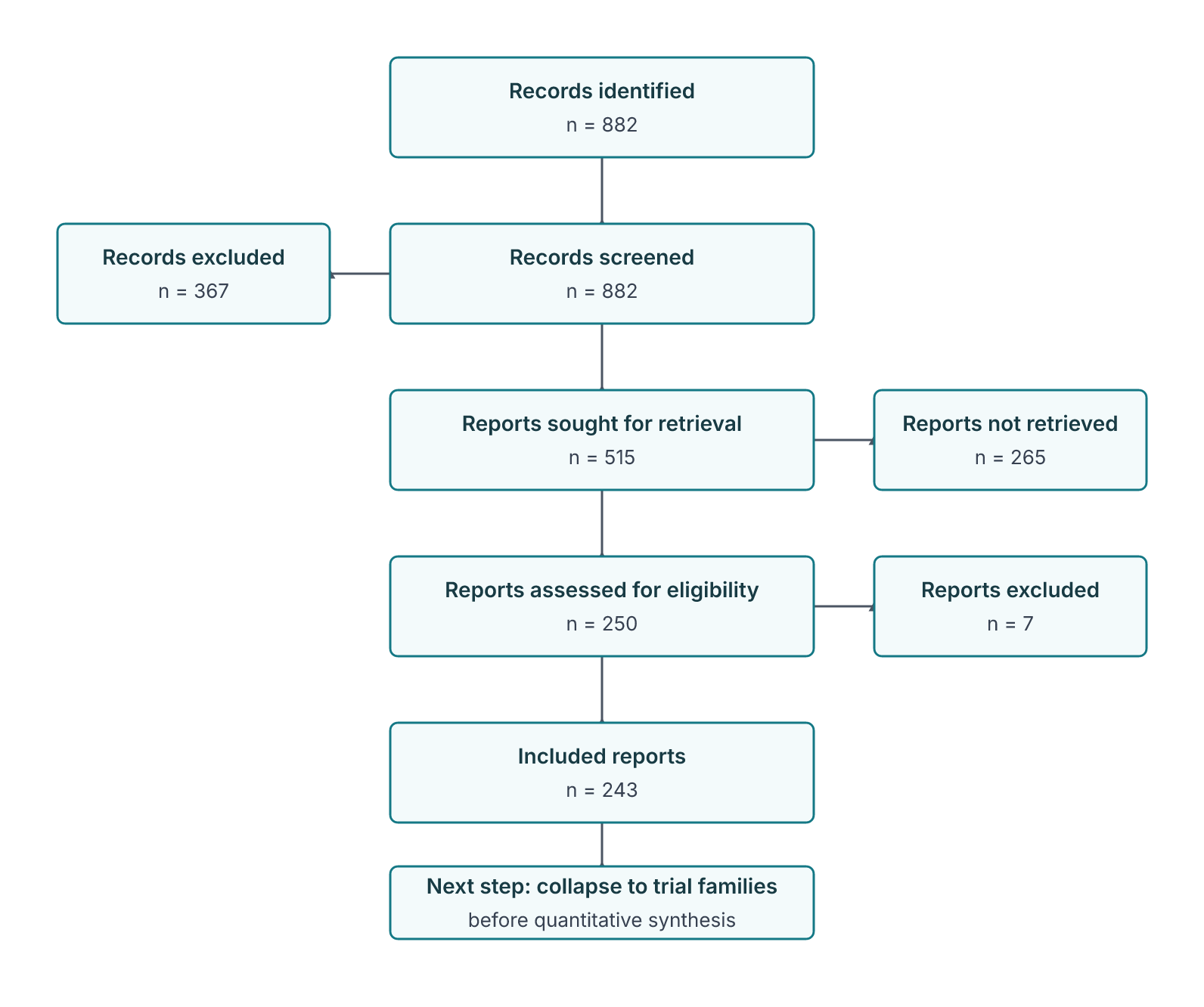
Εικόνα 1. Διάγραμμα ροής για την ολοκληρωμένη ανασκόπηση. Η ανάλυση θα διατηρήσει τις 265 αναφορές που δεν ανακτήθηκαν ως ξεχωριστή κατηγορία PRISMA αντί να τις αντιμετωπίσει ως ακατάλληλες.
Μέθοδοι και ιεραρχία τεκμηρίων
Η ολοκληρωμένη ανασκόπηση εξέτασε 882 καταγραφές, αναζήτησε 515 αναφορές προς ανάκτηση και διατήρησε 243 αναφορές μετά τον έλεγχο πλήρους κειμένου. Το διάγραμμα PRISMA διατηρεί τη μη ανάκτηση χωριστά από τους αποκλεισμούς λόγω ακαταλληλότητας. Προτού οριστικοποιηθούν τα ποσοτικά συμπεράσματα, πολλαπλές αναφορές από την ίδια τυχαιοποιημένη ομάδα πρέπει να συγχωνευθούν σε μια οικογένεια δοκιμών· ο πίνακας 50 γραμμών παρακάτω είναι επομένως ένας χάρτης τεκμηρίων σε επίπεδο ουσίας, και όχι μια μετα-ανάλυση.[2]
Η ιεραρχία είναι η εξής: άμεσα αυτόνομα στοιχεία (ελεγχόμενα RMSSD, HF-HRV, PEP, RSA ή συγκρίσιμα καρδιακά-βαγικά μέτρα), έμμεση φυσιολογία στρες (κορτιζόλη, άλφα-αμυλάση, GSR, κατεχολαμίνες) και στη συνέχεια εκβάσεις αναφερόμενες από τον ασθενή. Ένα τελικό σημείο χαμηλότερου επιπέδου δεν μπορεί να τεκμηριώσει την παρασυμπαθητική ενεργοποίηση. Στη δοκιμή με τα αμύγδαλα, η ισχύς HF ερμηνεύεται ρητά ως μέτρο αναπνευστικής ρύθμισης του πνευμονογαστρικού νεύρου, ενώ ο λόγος LF/HF έχει αμφισβητούμενη φυσιολογική σημασία.[1]
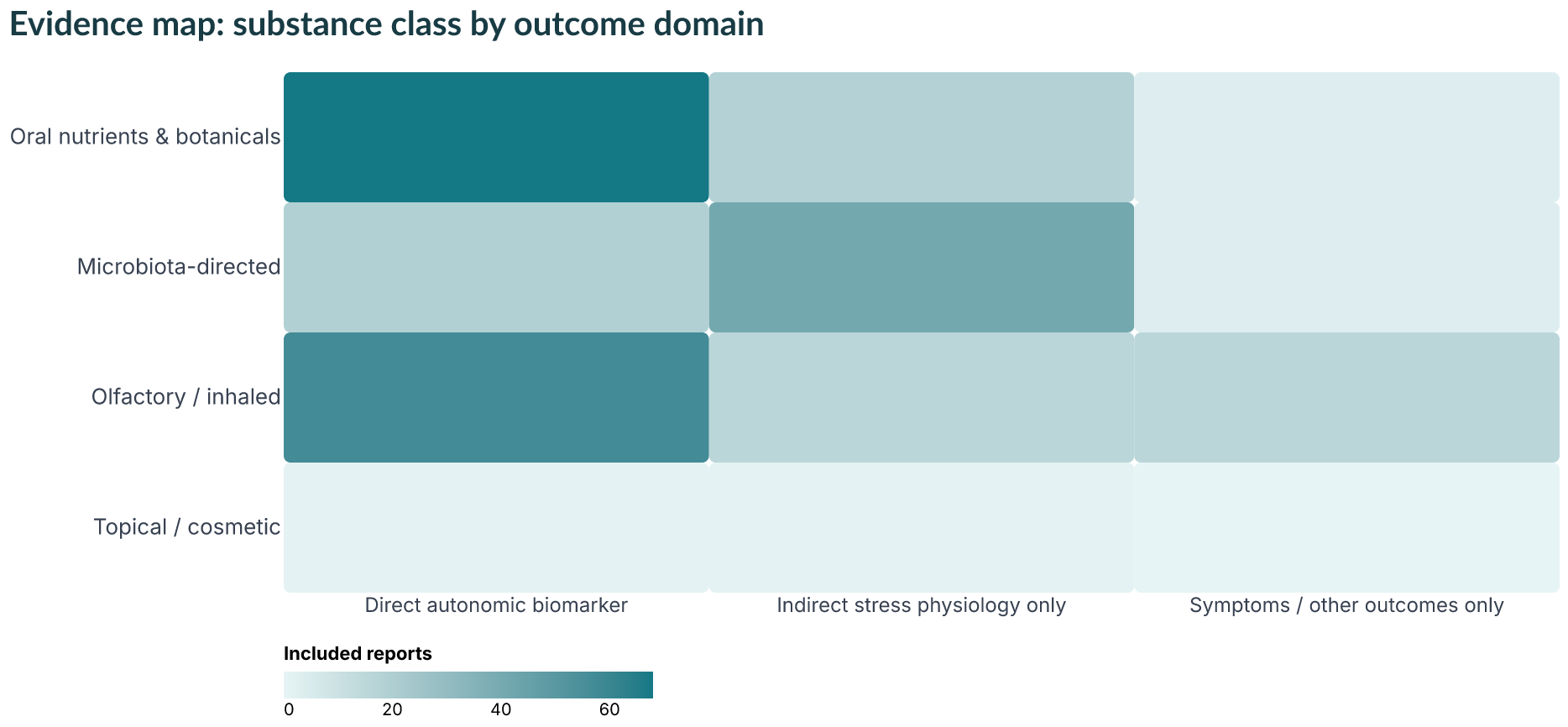
Εικόνα 2. Χάρτης σε επίπεδο αναφοράς της ολοκληρωμένης ανασκόπησης. Κάθε συμπεριλαμβανόμενη αναφορά κωδικοποιήθηκε βάσει της οδού χορήγησης και της ταυτότητας του συστατικού της, καθώς και ανάλογα με το αν ανέφερε άμεσο αυτόνομο βιοδείκτη, αποκλειστικά έμμεση φυσιολογία στρες ή μόνο συμπτώματα/άλλες εκβάσεις. Οι τιμές των κελιών είναι αριθμοί αναφορών, όχι κατεύθυνση επίδρασης, βεβαιότητα ή αριθμοί ανεξάρτητων δοκιμών· η αποδέσμευση διπλών εγγραφών ανά οικογένεια δοκιμών θα προηγηθεί της ποσοτικής σύνθεσης.
Υποψήφιο μηχανιστικό πλαίσιο
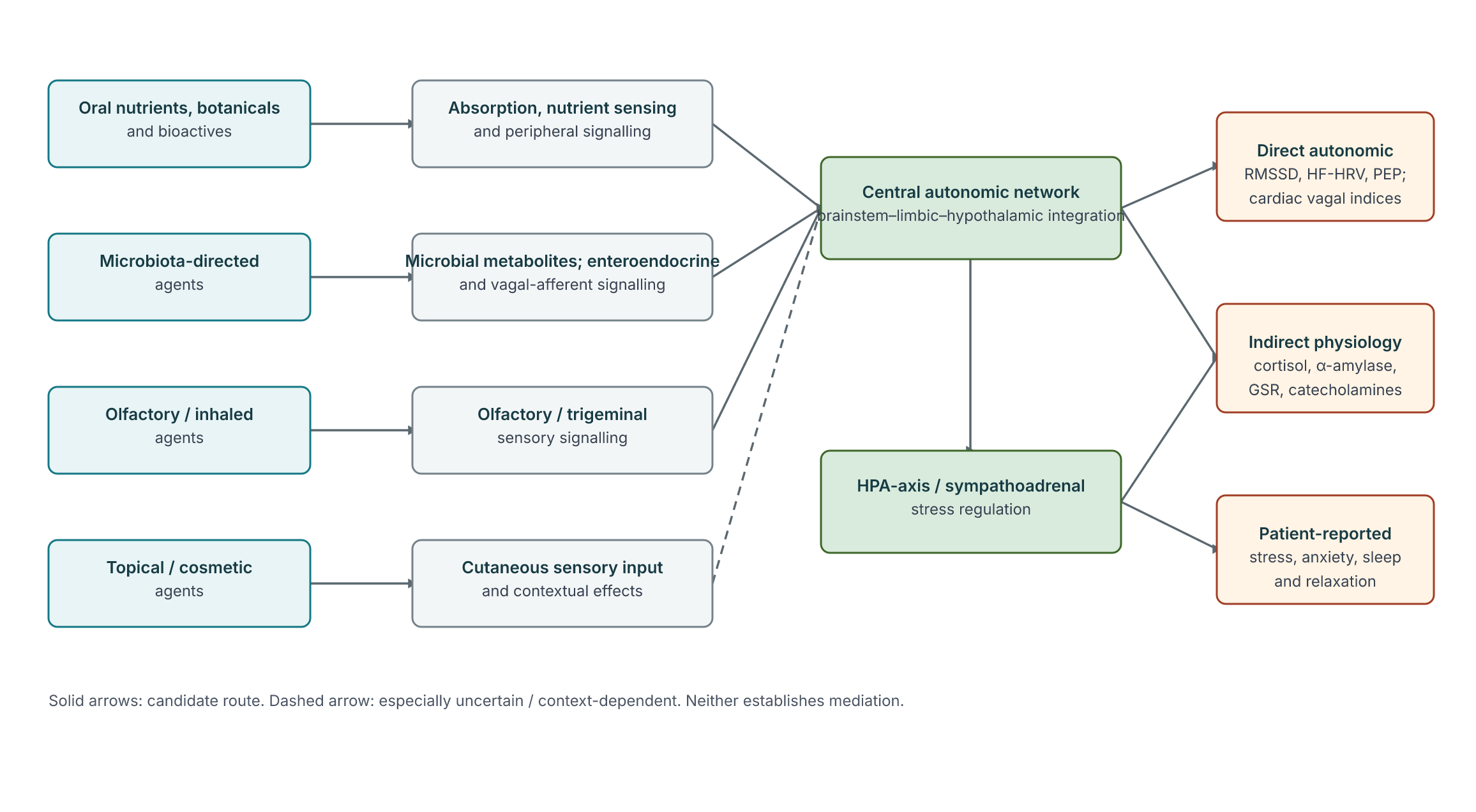
Εικόνα 3. Εννοιολογικό πλαίσιο για την ανασκόπηση. Τα βέλη υποδεικνύουν βιολογικά εύλογες υποψήφιες οδούς, και όχι αποδεδειγμένη μεσολάβηση στις συμπεριλαμβανόμενες δοκιμές. Η μελέτη θα διακρίνει τη μηχανιστική αιτιολόγηση από τα κλινικά στοιχεία αλλαγών στους βιοδείκτες του αυτόνομου νευρικού συστήματος ή του στρες.
Το διάγραμμα αποτελεί σκοpίμως ένα πλαίσιο υποψήφιων οδών. Οι ελεγχόμενες δοκιμές μπορούν να καταδείξουν μια αλλαγή βιοδείκτη αλλά σπάνια τεκμηριώνουν ότι μια προτεινόμενη οσφρητική, βαγική-προσαγωγός, ανοσομεταβολική ή οδός άξονα HPA τη μεσολάβησε. Για παράδειγμα, οι ερευνητές της μελέτης για τα αμύγδαλα απαριθμούν διάφορες πιθανές θρεπτικές, αγγειακές, βαροαντανακλαστικές, γλυκαιμικές και σχετιζόμενες με το στρες εξηγήσεις αντί να προσδιορίζουν έναν μόνο μηχανισμό.[1]
Κύριος χάρτης τεκμηρίων 50 ουσιών
Κανόνας ερμηνείας: Το «Άμεσο» σημαίνει ότι τουλάχιστον μία ελεγχόμενη ανθρώπινη αναφορά αξιολόγησε ένα καρδιακό-αυτόνομο μέτρο· δεν σημαίνει επαληθευμένη αποτελεσματικότητα. Το «Έμμεσο» σημαίνει ότι τα εξεταζόμενα ανθρώipινα δεδομένα ήταν κυρίως νευροενδοκρινούς, ηλεκτροδερματικής φύσης, ΗΕΓ ή σε επίπεδο συμπτωμάτων. Η «Υποψήφια οδός» είναι μια μηχανιστική υπόθεση, όχι ένας επιβεβαιωμένος μεσολαβητής. Το καθεστώς στην ΕΕ πρέπει να επαληθεύεται συστατικό προς συστατικό και δεν πρέπει να μετατρέπεται σε ισχυρισμό περί αυτόνομης υγείας. Αυτός ο κανόνας ταξινόμησης ακολουθεί την ιεραρχία τεκμηρίων που εφαρμόζεται στην παρούσα εργασία αντί να ισχυρίζεται αδειοδότηση ή αποτελεσματικότητα. Η διάκριση μεταξύ της ερμηνείας των HF/RMSSD και LF/HF βασίζεται στη συζήτηση μέτρησης της HRV της ελεγχόμενης δοκιμής με αμύγδαλα.[1]
| # | Ουσία / τυποποιημένος παράγοντας | Κατηγορία / οδός | Υποψήφια οδός | Ανώτατο επίπεδο έκβασης | Στάση τεκμηρίων |
|---|---|---|---|---|---|
| 1 | Ωμέγα-3 EPA+DHA | Από στόματος θρεπτικό συστατικό | Ηλεκτροφυσιολογία μεμβράνης· βαροαντανακλαστική/καρδιακή ανταπόκριση | Άμεσο | Ειδικό ανάλογα με το πλαίσιο άμεσο σήμα |
| 2 | Ολόκληρα αμύγδαλα | Τρόφιμο από του στόματος | Υποθέσεις διατροφικού προτύπου, αγγειακές και βαροαντανακλαστικές | Άμεσο | Μία ελεγχόμενη αναφορά δοκιμής στρες διαπίστωσε υψηλότερη ισχύ HF σε σύγκριση με τον μάρτυρα· οι άλλοι δείκτες δεν επηρεάστηκαν.[1] |
| 3 | L-θειανίνη | Από στόματος αμινοξύ | Γλουταματερ」。γική/GABAεργική ρύθμιση του στρες | Έμμεσο | Έμμεσο / μικτό |
| 4 | GABA | Από στόματος αμινοξύ | Εντερική και περιφερική σηματοδότηση GABA | Άμεσο | Πρώιμα άμεσα στοιχεία |
| 5 | Ταυρίνη | Από στόματος αμινοξύ | Ωσμωτική ρύθμιση και αυτόνομη ρύθμιση | Έμμεσο | Έμμεσο / μικτό |
| 6 | Γλυκίνη | Από στόματος αμινοξύ | Ανασταλτική νευροδιαβίβαση και φυσιολογία του ύπνου | Έμμεσο | Έμμεσο / μικτό |
| 7 | Μαγνήσιο | Από στόματος μέταλλο | Διεγερσιμότητα και αγγειακός τόνος | Έμμεσο | Έμμεσο / μικτό |
| 8 | Βιταμίνη Ε | Από στόματος βιταμίνη | Μηχανισμοί οξειδωτικού στρες και αγγειακοί μηχανισμοί | Άμεσο | Περιορισμένα άμεσα στοιχεία |
| 9 | Βιταμίνη C | Από στόματος βιταμίνη | Ρύθμιση οξειδοαναγωγής και άξονα στρες HPA | Έμμεσο | Έμμεσο / μικτό |
| 10 | Διαιτητικό νιτρικό άλας / παντζάρι | Βιοδραστικό συστατικό τροφίμων από το στόμα | Οδούς μονοξειδίου του αζώτου και βαροαντανακλαστικές οδούς | Άμεσο | Πρώιμα άμεσα στοιχεία |
| 11 | Χυμός καρπουζιού | Βιοδραστικό συστατικό τροφίμων από το στόμα | Σηματοδότηση κιτρουλίνης-NO | Άμεσο | Πρώιμα άμεσα στοιχεία |
| 12 | Υδρολυμένο άλφα-λακταλβουμίνη / τρυπτοφάνης | Από στόματος πεπτίδιο | Οδός σεροτονεργικού πρόδρομου | Άμεσο | Πρώιμα άμεσα στοιχεία |
| 13 | Λακτοφερρίνη | Από στόματος πεπτίδιο | Νευροανοσολογική σηματοδότηση και σηματοδότηση άξονα στρες | Έμμεσο | Έμμεσο / μικτό |
| 14 | Υδρολύμα άλφα-s1-καζεΐνης (Lactium) | Από στόματος πεπτίδιο | Βιοδραστικό πεπτίδιο / υπόθεση GABA-A | Έμμεσο | Έμμεσο / μικτό |
| 15 | Φωσφατιδυλοσερίνη + φωσφατιδικό οξύ | Από στόματος φωσfolipid | Αντιδραστικότητα άξονα HPA | Έμμεσο | Έμμεσο σήμα φυσιολογίας στρες |
| 16 | Εκχύλισμα Ashwagandha | Από στόματος βοτανικό | Υπόθεση άξονα HPA και προσαρμογής στο στρες | Έμμεσο | Έμμεσο / μικτό |
| 17 | Rhodiola rosea | Από στόματος βοτανικό | Υπόθεση προσαρμογής στο στρες / μονοαμινεργική υπόθεση | Έμμεσο | Έμμεσο / μικτό |
| 18 | Ιερός βασιλικός | Από στόματος βοτανικό | Υπόθεση προσαρμογής στο στρες | Έμμεσο | Έμμεσο / μικτό |
| 19 | Μελισσόχορτο | Από στόματος βοτανικό | GABAεργική/χολινεργική υπόθεση | Έμμεσο | Έμμεσο / μικτό |
| 20 | Φλοιός μανόλιας | Από στόματος βοτανικό | Υπόθεση GABA-A και άξονα HPA | Έμμεσο | Έμμεσο / μικτό |
| 21 | Κρόκος | Από στόματος βοτανικό | Μονοαμινεργική υπόθεση και υπόθεση άξονα HPA | Έμμεσο | Έμμεσο / μικτό |
| 22 | Εκχύλισμα Maqui | Από στόματος πολυφαινόλη | Οξειδοαναγωγική / ενδοθηλιακή υπόθεση | Άμεσο | Πρώιμα άμεσα στοιχεία |
| 23 | Εκχύλισμα σπαραγγιού κατεργασμένο με ένζυμα | Από στόματος βοτανικό | Υπόθεση άξονα στρες | Έμμεσο | Έμμεσο / μικτό |
| 24 | Acanthopanax senticosus | Από στόματος βοτανικό | Υπόθεση προσαρμογής στο στρες και καρδιακής-αυτόνομης ρύθμισης | Άμεσο | Πρώιμα άμεσα στοιχεία |
| 25 | L-καρνιτίνη | Από στόματος θρεπτικό συστατικό | Μιτοχondriακός και καρδιακός μεταβολισμός | Άμεσο | Αναφέρθηκε δυσμενές άμεσο σήμα |
| 26 | Lactobacillus gasseri CP2305 (θερμικά επεξεργασμένος) | Μεταβιοτικό | Υπόθεση άξονα εντέρου-εγκεφάλου / εντεροενδοκρινούς-βαγικής οδού | Άμεσο | Οξύ άμεσο σήμα |
| 27 | Lactobacillus casei Shirota | Προβιοτικό | Οδός μικροβιώματος-ανοσοποιητικού-HPA | Έμμεσο | Έμμεσο / μικτό |
| 28 | Lactiplantibacillus plantarum PS128 | Προβιοτικό | Οδός μικροβιώματος-νευροενδοκρινούς συστήματος | Έμμεσο | Έμμεσο / μικτό |
| 29 | Lactiplantibacillus plantarum P8 | Προβιοτικό | Οδός μικροβιώματος-άξονα στρες | Έμμεσο | Έμμεσο / μικτό |
| 30 | Bifidobacterium longum 1714 | Προβιοτικό | Οδός εντέρου-εγκεφάλου και αντιδραστικότητας στο στρες | Άμεσο | Πρώιμα άμεσα στοιχεία |
| 31 | Bifidobacterium longum NCC3001 | Προβιοτικό | Οδός εντέρου-εγκεφάλου / ανοσοποιητικού | Έμμεσο | Έμμεσο / μικτό |
| 32 | Lactobacillus helveticus R0052 + B. longum R0175 | Προβιοτικό | Οδός μικροβιώματος-HPA | Έμμεσο | Έμμεσο / μικτό |
| 33 | OMNi-BiOTiC STRESS Repair | Πολυστελεχικό προβιοτικό | Οδός μικροβιώματος-αυτόνομου νευρικού συστήματος | Άμεσο | Πληθυσμιακά περιορισμένο άμεσο σήμα |
| 34 | Saccharomyces boulardii CNCM I-1079 | Προβιοτική ζύμη | Μικροβίωμα–φυσιολογία στρες | Έμμεσο | Έμμεσο / μικτό |
| 35 | Ινουλίνα | Πρεβιοτικό | Σηματοδότηση SCFA και εντεροενδοκρινής σηματοδότηση | Έμμεσο | Έμμεσο / μικτό |
| 36 | Γαλακτο-ολιγοσακχαρίτες (GOS) | Πρεβιοτικό | Οδός SCFA και μικροβιώματος-HPA | Έμμεσο | Έμμεσο / μικτό |
| 37 | Βουτυρικό νατρίου | Μεταβιοτικό / SCFA | Σηματοδότηση FFAR και εντεροενδοκρινής σηματοδότηση | Έμμεσο | Έμμεσο / μικτό |
| 38 | Αιθέριο έλαιο περγαμόντου | Οσφρητικό | Οσφρητική–μεταιχμιακή–αυτόνομη οδός | Άμεσο | Άμεσο αλλά αισθητηριακά μη τυφλό |
| 39 | Αιθέριο έλαιο λεβάντας | Οσφρητικό / τοπικό | Οσφρητική–μεταιχμιακή ή δερματική αισθητηριακή οδός | Άμεσο | Μικρό / εξαρτώμενο από το πλαίσιο |
| 40 | Λιναλοόλη | Οσφρητικό | Οσφρητική–μεταιχμιακή οδός | Άμεσο | Πρώιμα άμεσα στοιχεία |
| 41 | Οξική λιναλυλεστέρα | Οσφρητικό | Οσφρητική–μεταιχμιακή οδός | Έμμεσο | Έμμεσο / μικτό |
| 42 | β-Καρυοφυλλένιο | Οσφρητικό | Οσφρητική αισθητηριακή υπόθεση και υπόθεση CB2 | Άμεσο | Πρώιμα άμεσα στοιχεία |
| 43 | Κιτράλη | Οσφρητικό | Οσφρητική αισθητηριακή οδός | Άμεσο | Πρώιμα άμεσα στοιχεία |
| 44 | Αιθέριο έλαιο πορτοκαλιού | Οσφρητικό | Οσφρητική–μεταιχμιακή οδός | Άμεσο | Πρώιμα άμεσα στοιχεία |
| 45 | Αιθέριο έλαιο Yuzu | Οσφρητικό | Οσφρητική–μεταιχμιακή οδός | Άμεσο | Πρώιμα άμεσα στοιχεία |
| 46 | Αιθέριο έλαιο νερολί | Οσφρητικό | Οσφρητική–μεταιχμιακή οδός | Έμμεσο | Έμμεσο / μικτό |
| 47 | Αιθέριο έλαιο Υλάνγκ-Υλάνγκ | Οσφρητικό | Οσφρητική–μεταιχμιακή οδός | Έμμεσο | Έμμεσο / μικτό |
| 48 | Ξύλο κέδρου / κεδρόλη | Οσφρητικό | Οσφρητική αισθητηριακή οδός | Άμεσο | Πρώιμα άμεσα στοιχεία |
| 49 | Τερπένια φυτοκτόνων | Οσφρητικό | Οσφρητική αισθητηριακή οδός | Άμεσο | Πρώιμα άμεσα στοιχεία |
| 50 | Αιθέριο έλαιο τριαντάφυλλου | Οσφρητικό | Οσφρητική–μεταιχμιακή οδός | Έμμεσο | Έμμεσο / μικτό |
Ερμηνεία σταθμισμένη βάσει τεκμηρίων
Ο πίνακας δεν αποτελεί σκόπιμα κατάλογο κατάταξης προϊόντων. Το πιο ουσιαστικό ερώτημα για κάθε υποψήφιο είναι κατά πόσον μια μεταβολή στο RMSSD, στο HF-HRV, στο RSA ή στο PEP —συγκριτικά με εικονικό φάρμακο ή ομάδα ελέγχου— αναπαράγεται σε πληθυσμό και πλαίσιο συναφή με την προβλεπόμενη χρήση. Τα άμεσα αποδεικτικά στοιχεία που προκύπτουν από μία μικρή, οξεία αισθητηριακή μελέτη ή από σκεύασμα πολλαπλών συστατικών δεν πρέπει να μεταφέρονται σε έναν ισ Aυτονόμου Συστήματος σε επίπεδο καταναλωτή. Το επόμενο βήμα σύνταξης του χειρογράφου είναι ένας έλεγχος (audit) της οικογένειας δοκιμών, που ακολουθείται από εξαγωγή μεγέθους επίδρασης μόνο στις περιπτώσεις όπου οι υποκείμενες αναφορές παρέχουν συμβατικούς μέσους όρους, μέτρα διασποράς, χρονικά σημεία και ομάδες σύγκρισης. Η ανάγκη αποδελτίωσης και αφαίρεσης διπλοεγγραφών (deduplicate) των αποδεικτικών στοιχείων σε επίπεδο αναφοράς πριν από την ποσοτική σύνθεση είναι ρητή στον έλεγχο ροής αναθεώρησης.[2]
Στοιχεία από το έγγραφο πηγής